
This is an audio- and touch-reactive table designed for intentional conversation. Participants spin two concentric rings to align the themes and framing they intend to focus on, and begin.
The fact that the rings remain spinnable allows conversation to shift, as the participants’ discussion refocuses what’s most meaningful to them individually and collectively.
As new topics or framing lines up, the table emits a new soundscape or light display
I can manage the fabrication, but I’m seeking collaborators today at the Electric SEA hackathon. I’m looking for an illustrator, a sound designer and an interactive-circuit designer to help rough out the prototype – and then collaborate to deliver the end product.
I’ll be in the building for the duration of the hackathon – if you don’t see me, DM me on Discord.
This project is seeking:
-
Hardware/software sound and light artists to develop the interaction design
-
Visual artists to realize the look and iconography
The artist will fabricate the table and collaborate with the team to integrate their creations.
Contact: factoid@well.com
Formal Description:
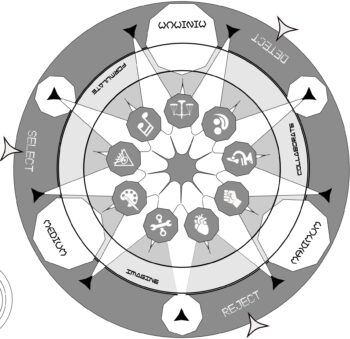
Prototype (1:6-scale) for a 7-foot-diameter meeting node to inspire conversation among up to 9 random participants or focus a small team’s energies.
Behavior: As participants use the table to select topics and framing, embedded sensors trigger software to generate sounds and light patterns that match the selection. Light and sound can be tuned to be constant, intermittent, or timed, based on the participants’ needs and intention.
Planned materials: Inlaid, laser-cut, or painted wood or etched aluminum and embedded electronics, sensors, and sound/light emitters, coated with high-durability satin urethane.
HOW TO USE TABLE 9:
A) Arrive at the table with a group or team and your session framing in mind. Why are you here?
(e.g. Project development, brainstorming session, reverse-psychology exercise, problem solving, helpfinding, envisioning, story time, game)
OR
B) Gather up to 8 or more strangers and spin the rings to let the table drive.
The outermost ring is stationary to allow placement of coffee cups, phones, notebooks, etc.
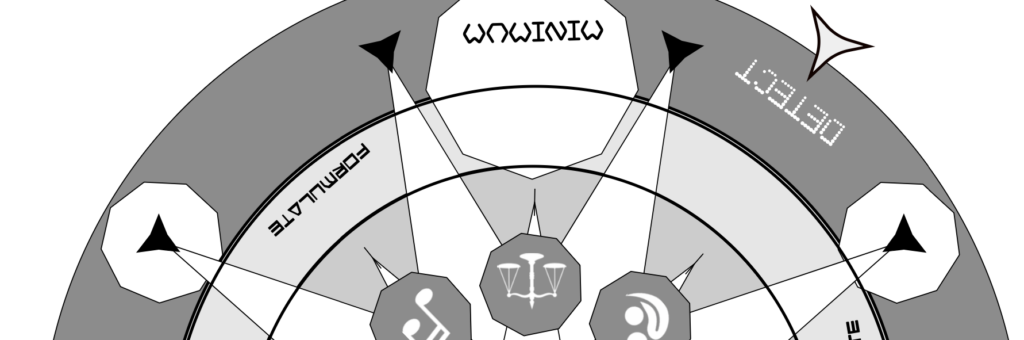
Each nested ring has a set of discussion parameters on it. These could be anything from topics to specific flavors, mythologies, or contexts, e.g.,
-
Intensity/Scope (Minimum, Medium, Maximum)
-
Intention (Select, Detect, Reject)
-
Framing/Topic (icons for Nature, Music, Art, Mysticism, Law, Politics, etc.)
-
and/or Role of the person seated by that symbol
-
e.g. Participant, Mediator, Scribe, Devil’s Advocate, Chaos Agent, etc.
-
-
Spin the center icons to set your framing or topic (or, let the group choose the framing)
-
Spin another ring to select the next parameter (Intensity, Intention, Role, etc.)
-
Talk amongst yourselves – and adjust the table as the conversation flows and evolves.