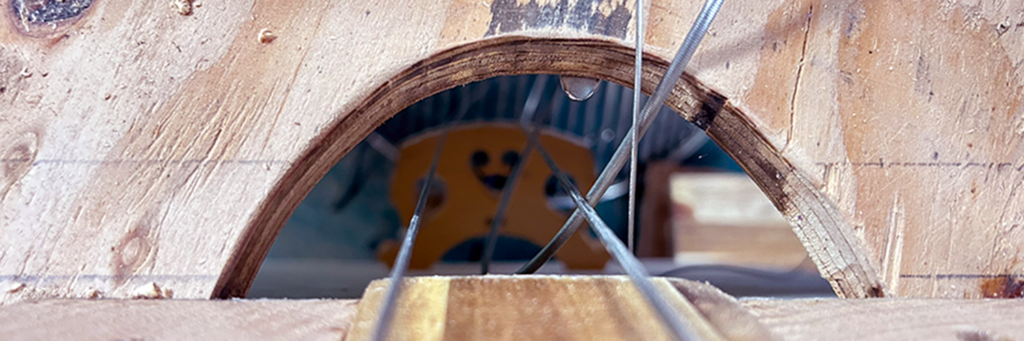
 One must marvel at the gorgeous form and function of a double-bass viol’s body;
Those sexy curves and f-shaped holes, rendered in fine varnished wood, are explicitly designed to sing sweetly when the strings are bowed or plucked.
But I’m just a brutish carpenter, so instead I made a box. The Jam Table’s architectural requirements for the bass are just plain weird:
- Must sound good, and fully resonate bass frequencies made by the musician
- Must fit between the floor and the underside of the table.
- Must fit outside of the diameter of the table base, allowing room for the strings to move
- Must be REMOVABLE so that the whole Jam Table can be broken down into components to be moved from my shop to its destination
- Must not look like complete crap
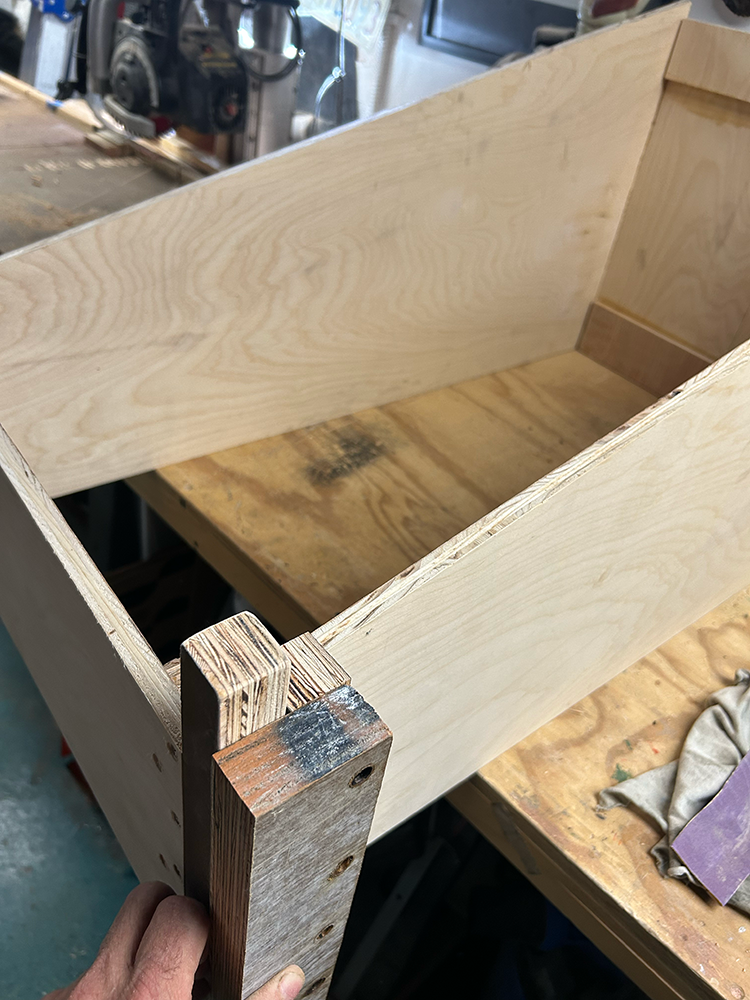
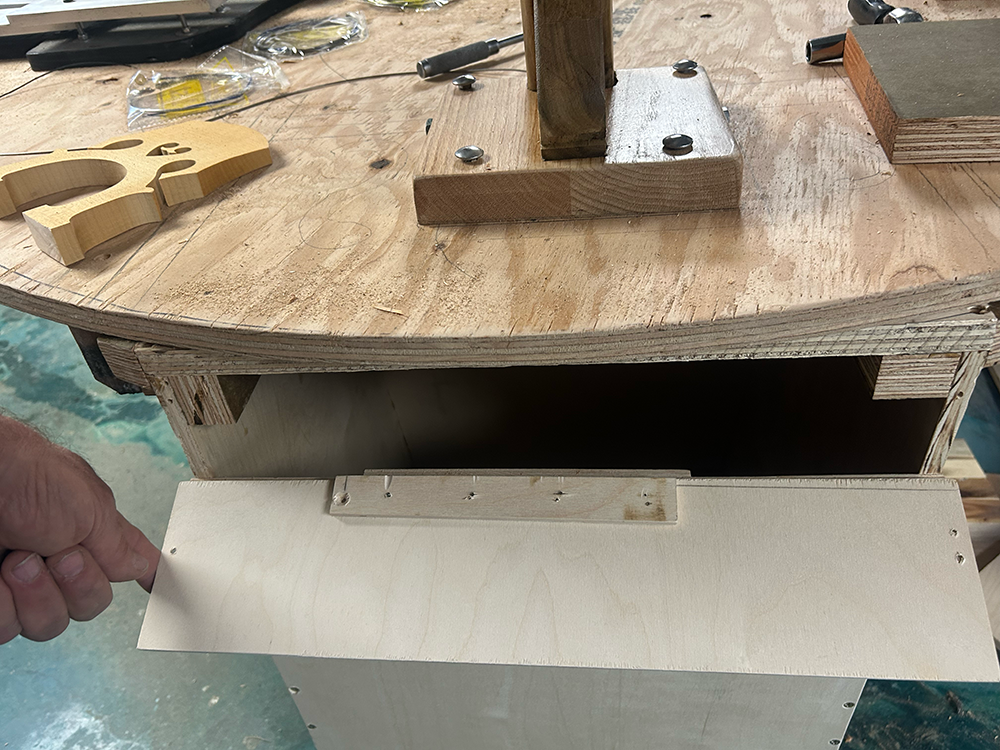
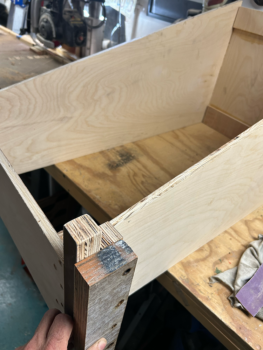
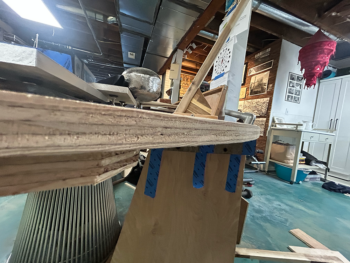 I used 1/2-inch birch plywood for the frame – glued and screwed – and then 1/8-inch plywood sheets for the front and rear resonant surfaces.
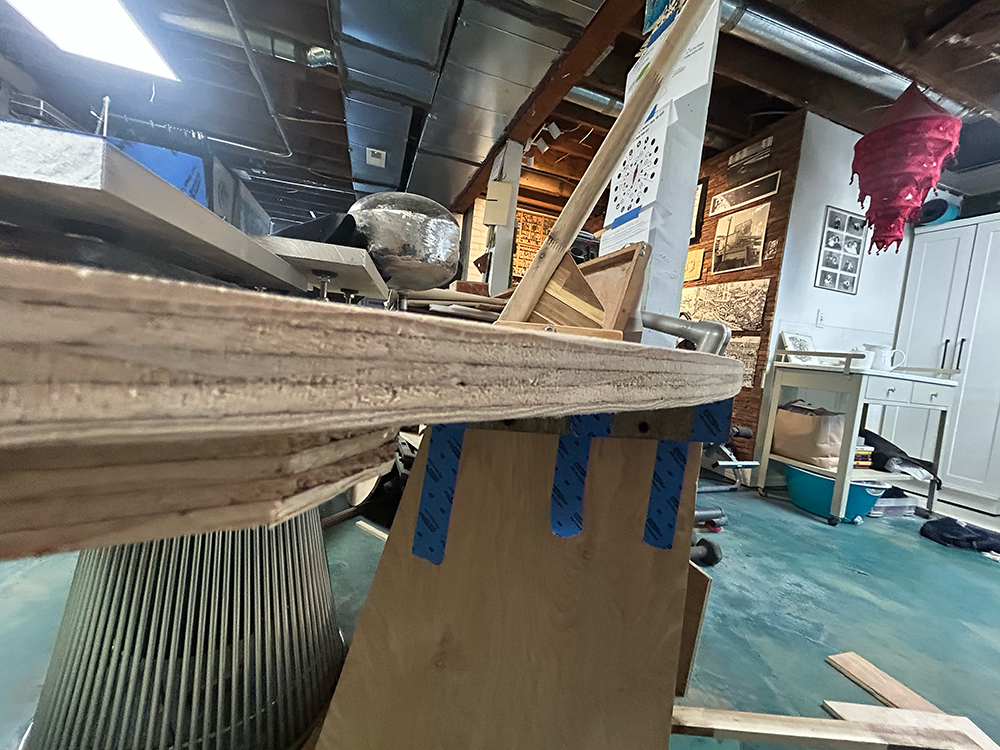
I slanted the front to be thicker at the bottom (to get as much resonant volume as possible) and thinner at the top (to clear the stainless steel tips of the table base where it flares outward).
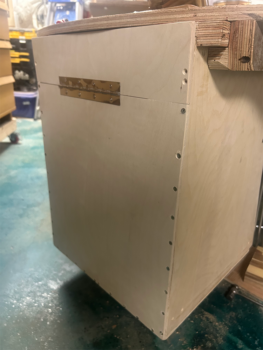 The other goal was to have it align well with the angle of the neck and strings – which was going to be total guesswork until I could make a way to align it all.
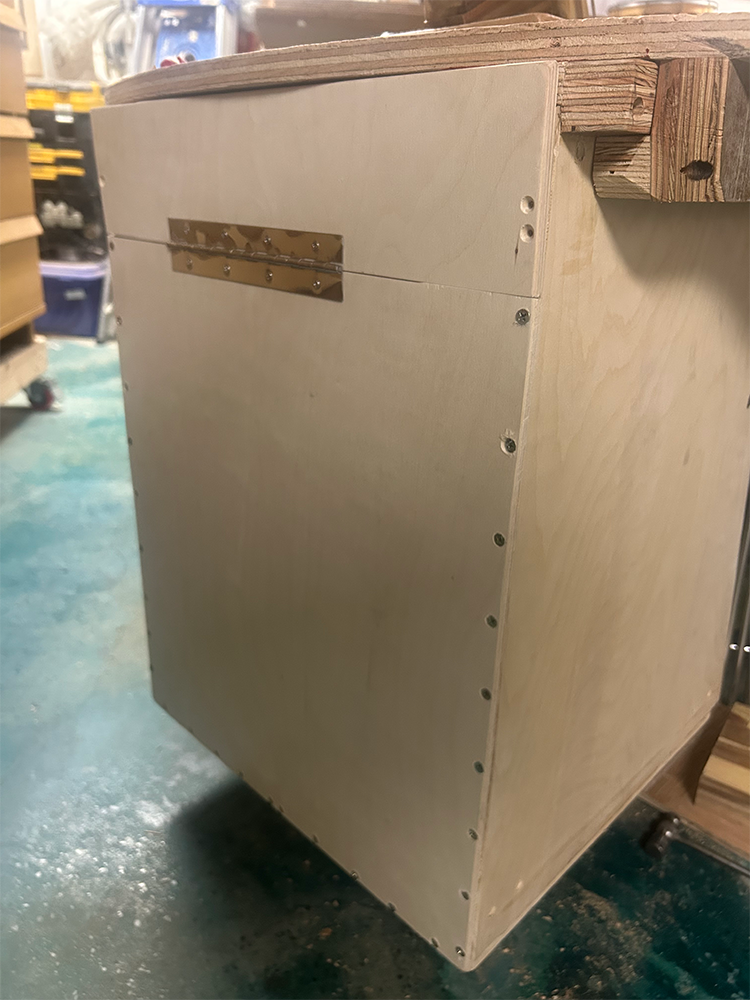
The next trick was to make it removable: I attached rails of thick 1.5-inch plywood to the underside of the table, and fins to the top of the sound box, allowing it to be slid into the rails and held flush with the table’s underside.
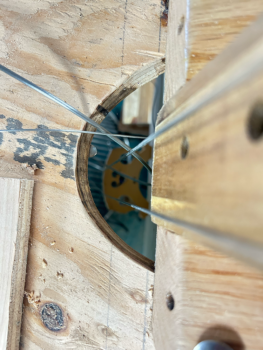
Finally – and this wound up being a little silly – I had to build an access hatch into the back of the box so that I can reach the bolts that attach the neck to the table top. I’m hoping that the gaps and non-air-tightness of the rear of the instrument doesn’t bleed off its resonance.
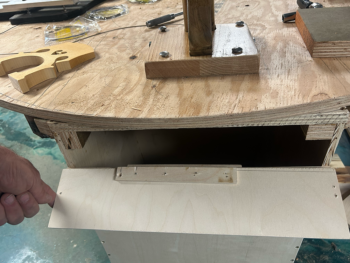 With all of this nonsense in place, I can now slide the box in or out to change the action on the strings.
Which turns out to be a good thing; Installing the strings was finicky, and messy.
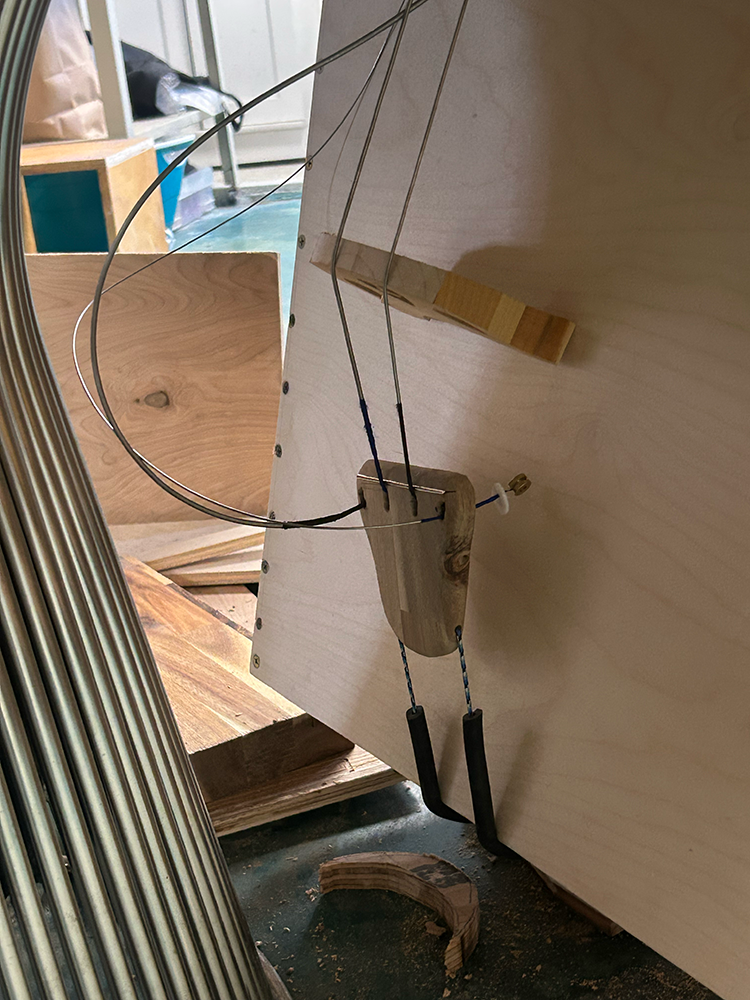
I made an adjustable end-pin (the metal dingus sticking out of the bottom of a double bass that lets it stand on the floor) out of a carriage bolt fixed with T-nuts into the bottom of the box.
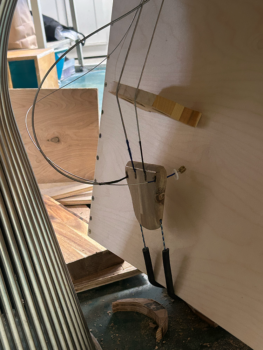 Then I fashioned a tailpiece out of acacia to anchor the strings, and lashed it to the endpin with paracord (slipknots make it adjustable) and I started the finicky business of installing the strings.
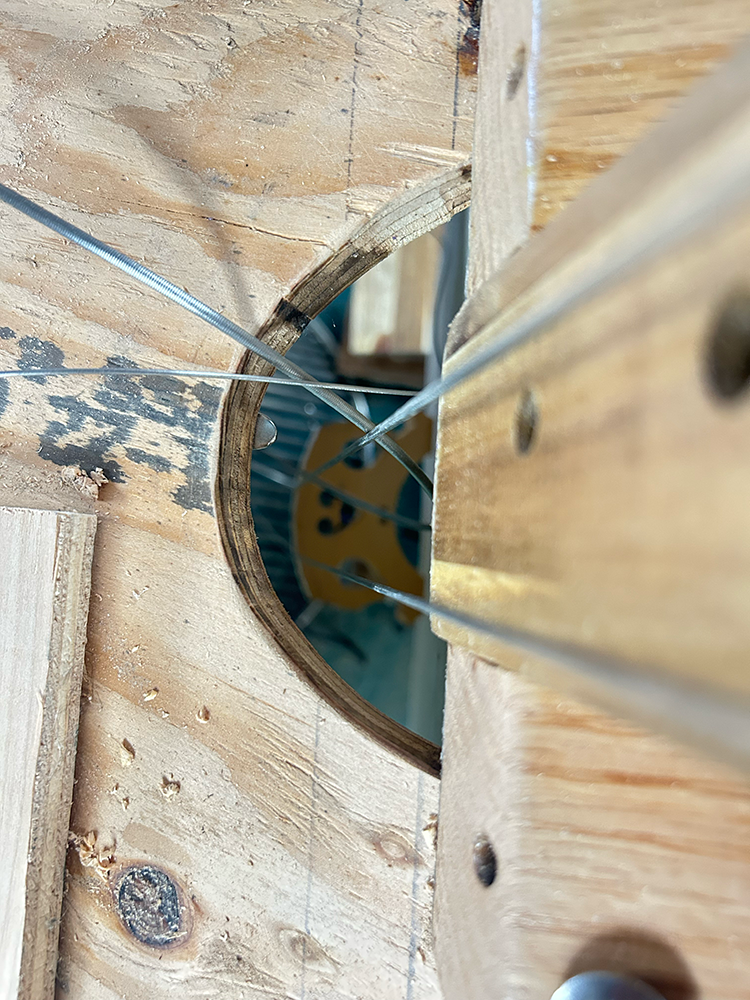
This is not nearly as straightforward as stringing a guitar: The bridge is meant to float on the top of a double-bass so that you can be positioned at the right spot (43.5 inches or so from the nut). Once you start tightening the strings, they drag the bridge off plumb, and you have to readjust it (I tapped it back into line with a hammer).
 The tension on the strings is hellacious; As the E comes into line, it pulls the other strings out of tune. Fix the D, and the E and A go flat. Fix them, and now the D and G go flat.
At the same time, the string tension starts pulling the peghead forward, slightly bowing the neck and changing the action; Before, the strings were nice and low – now there’s a 1-inch gap between them and the 12th-fret position.
I eventually pulled it all back into line, got the thing tuned, and it sounds proper. I just have to scooch the box forward a hair to lower the action.
 Stay tuned!
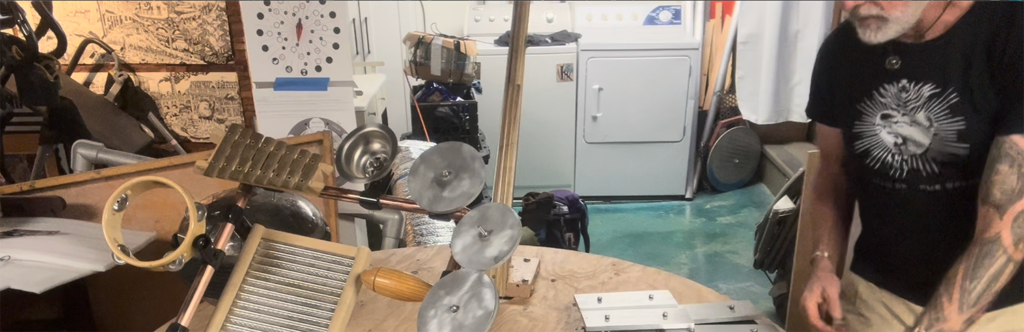
 Everything is (finally!) built, and any four musicians can step up and jam.