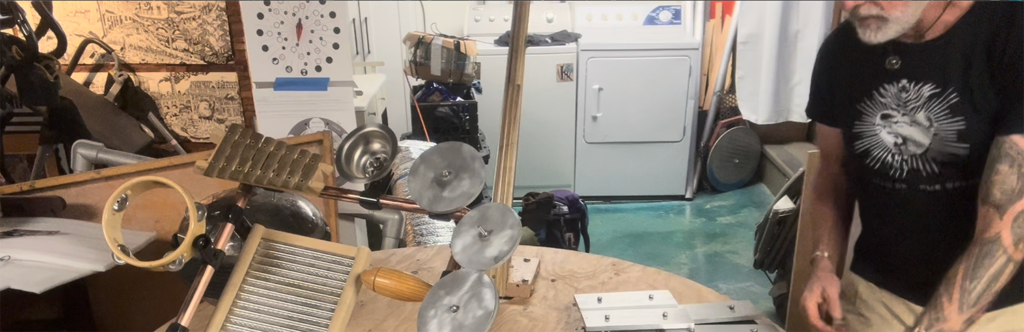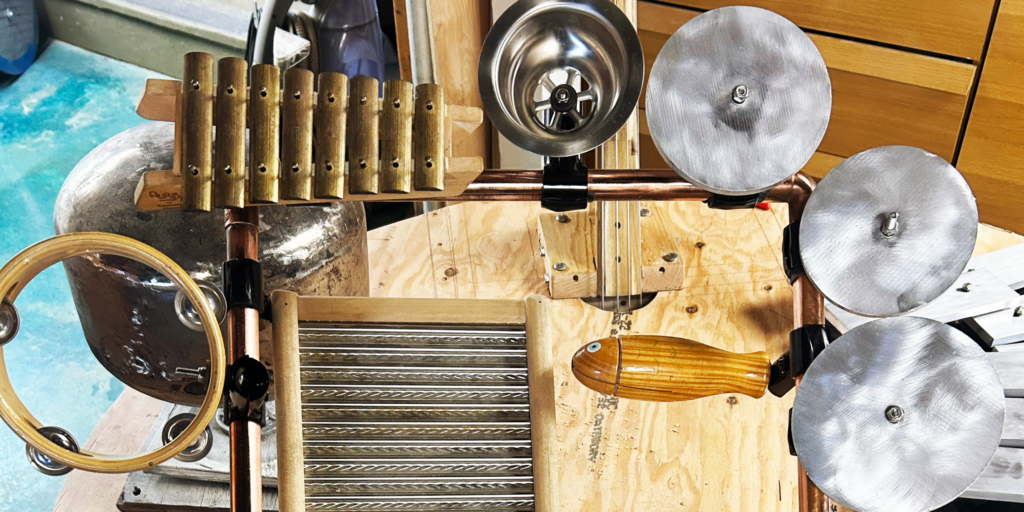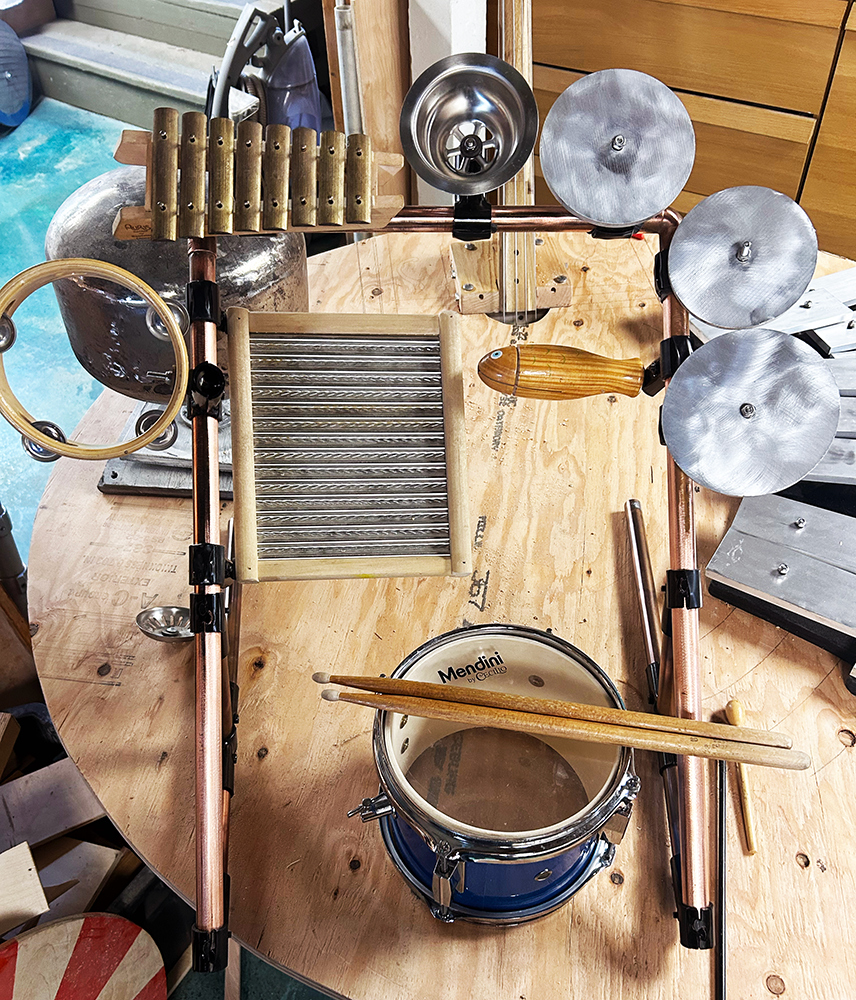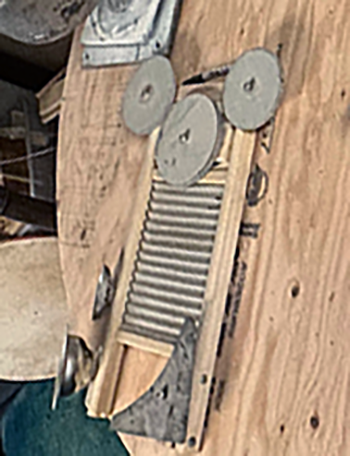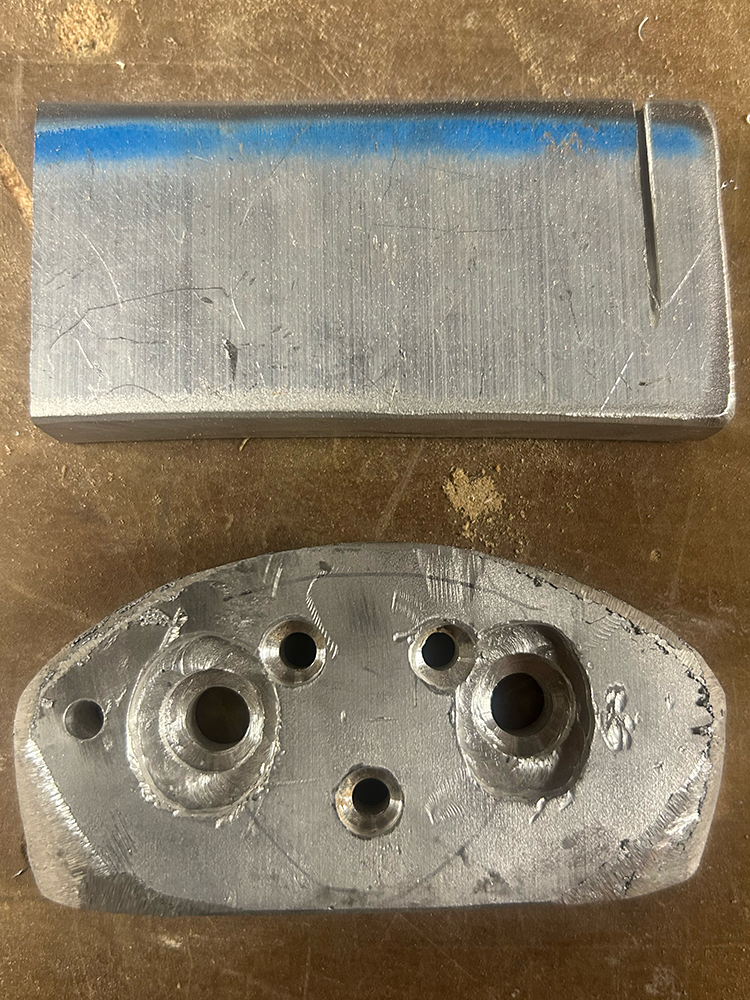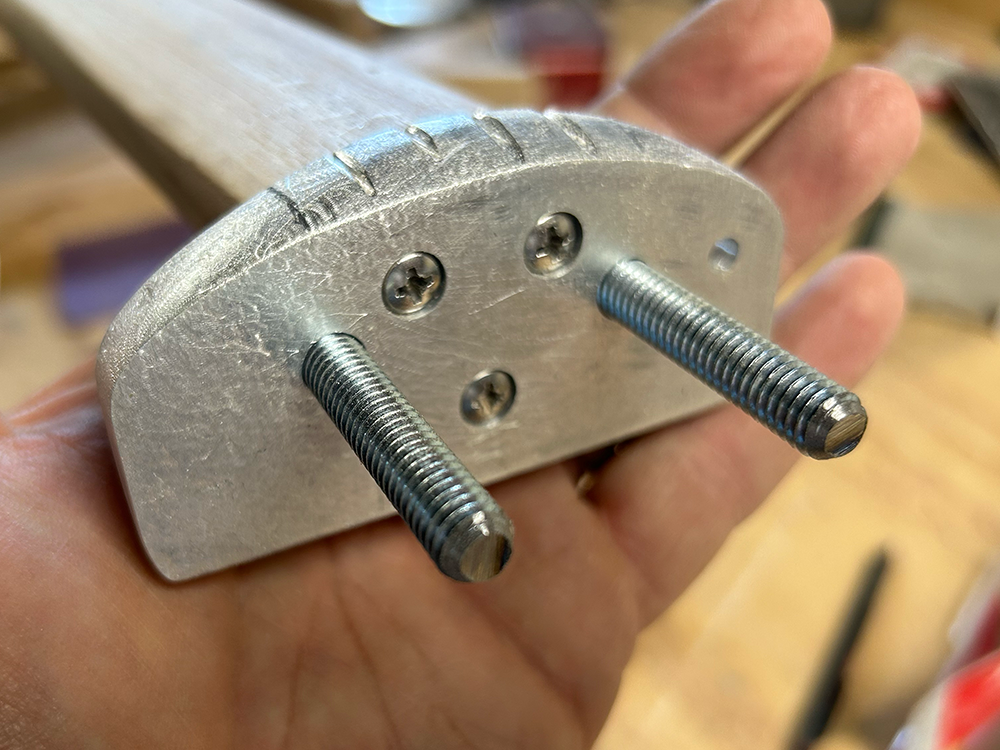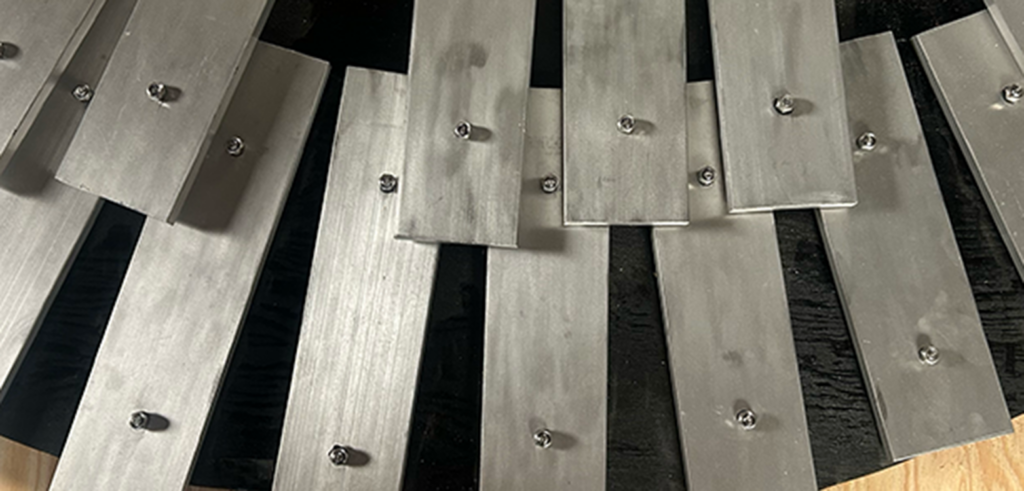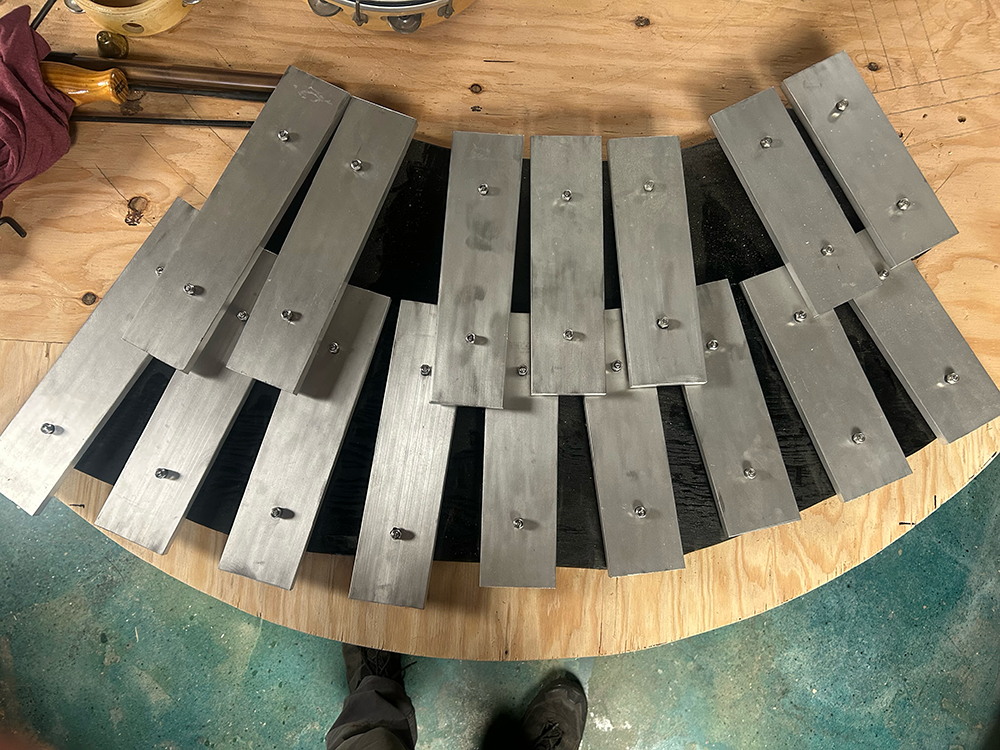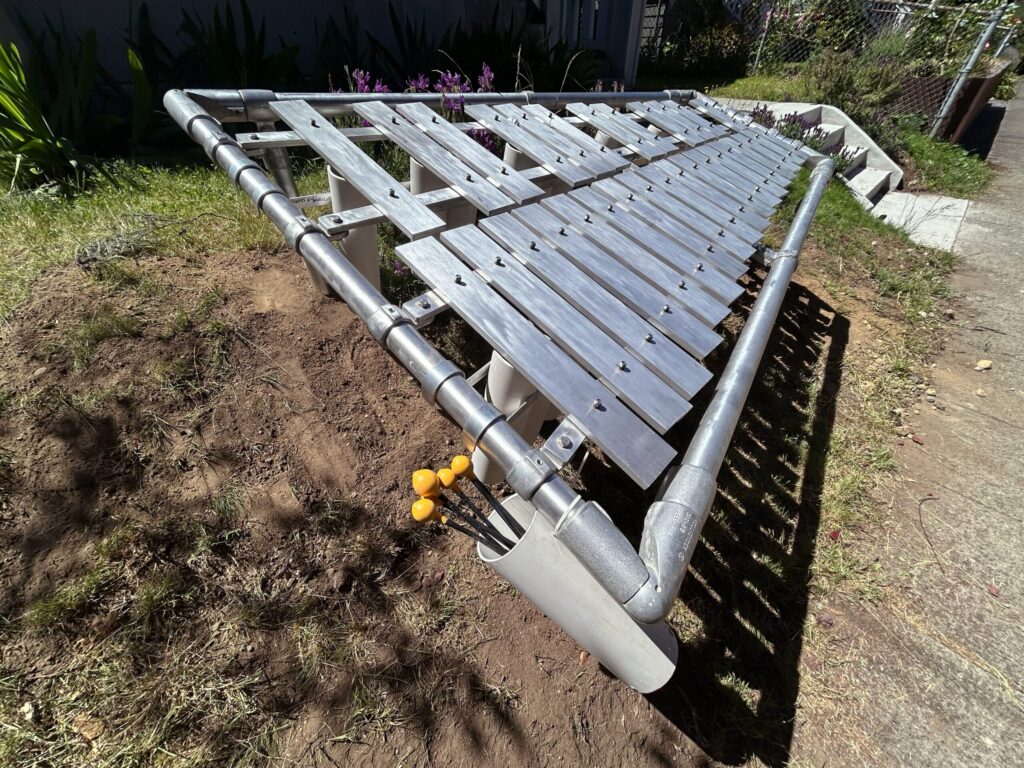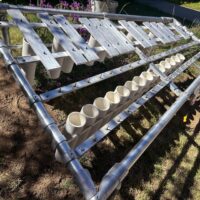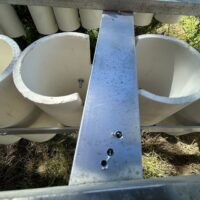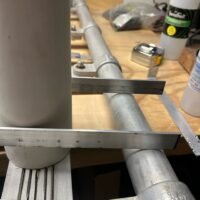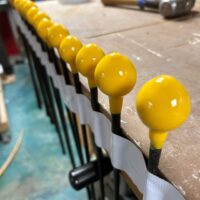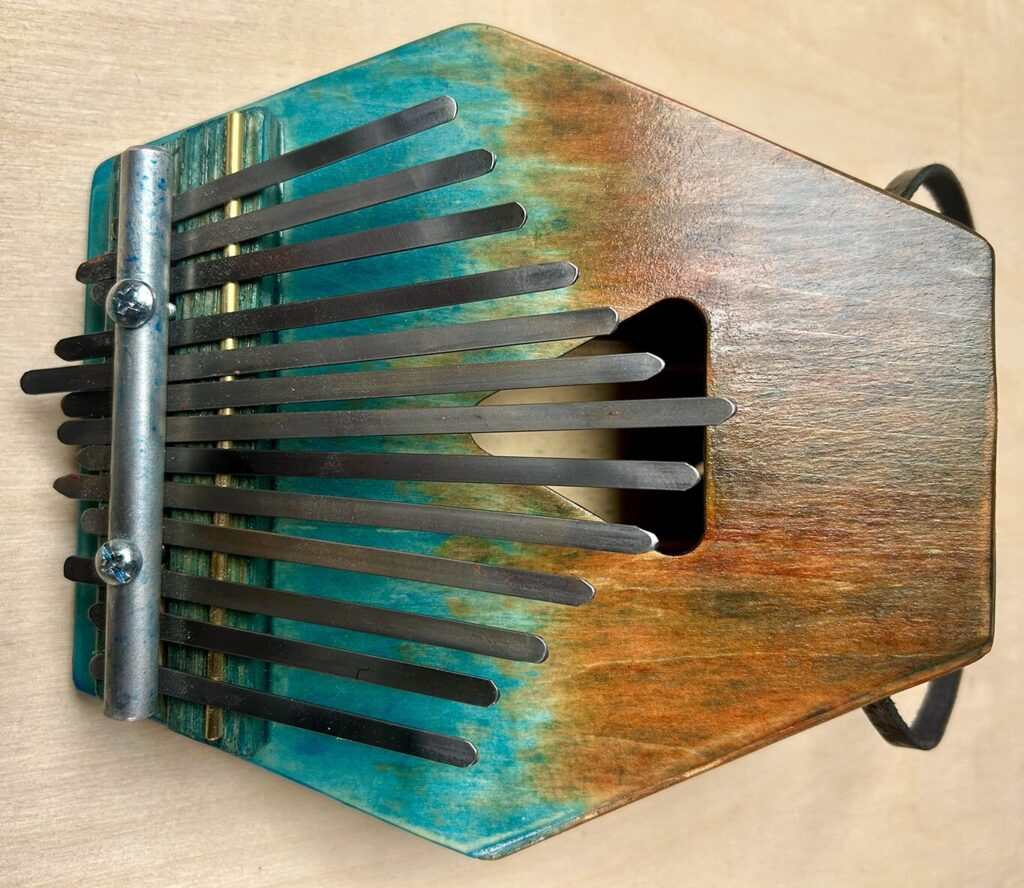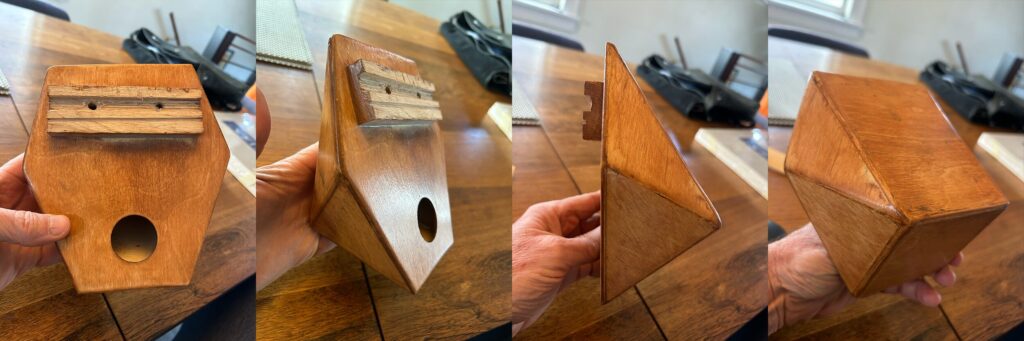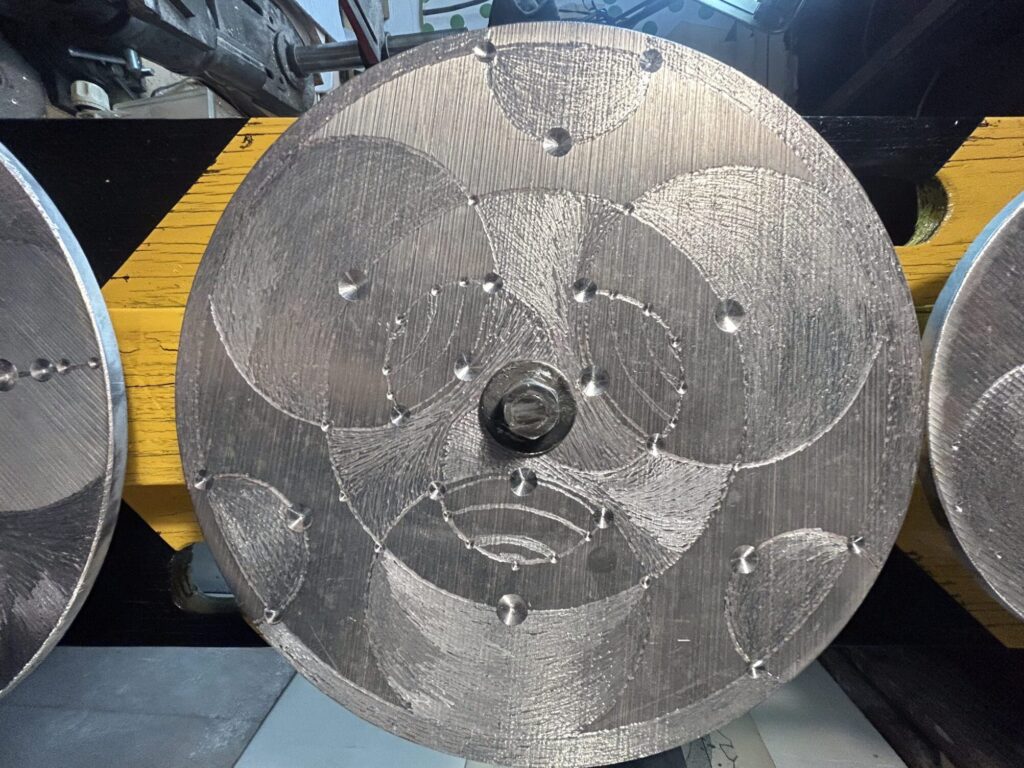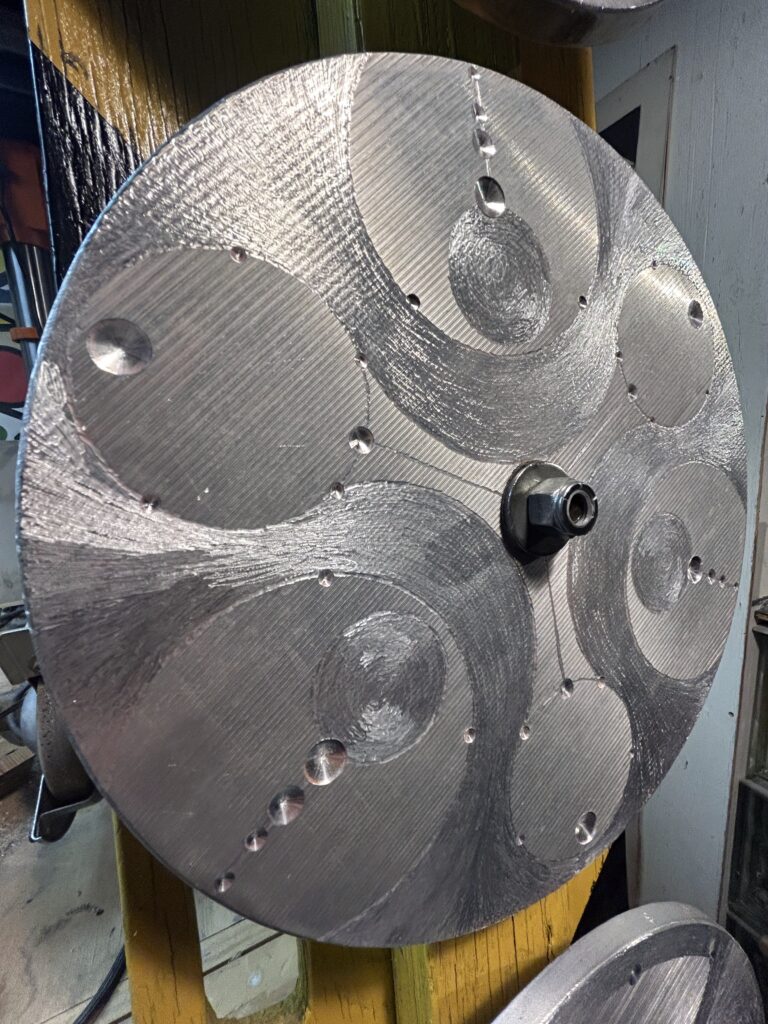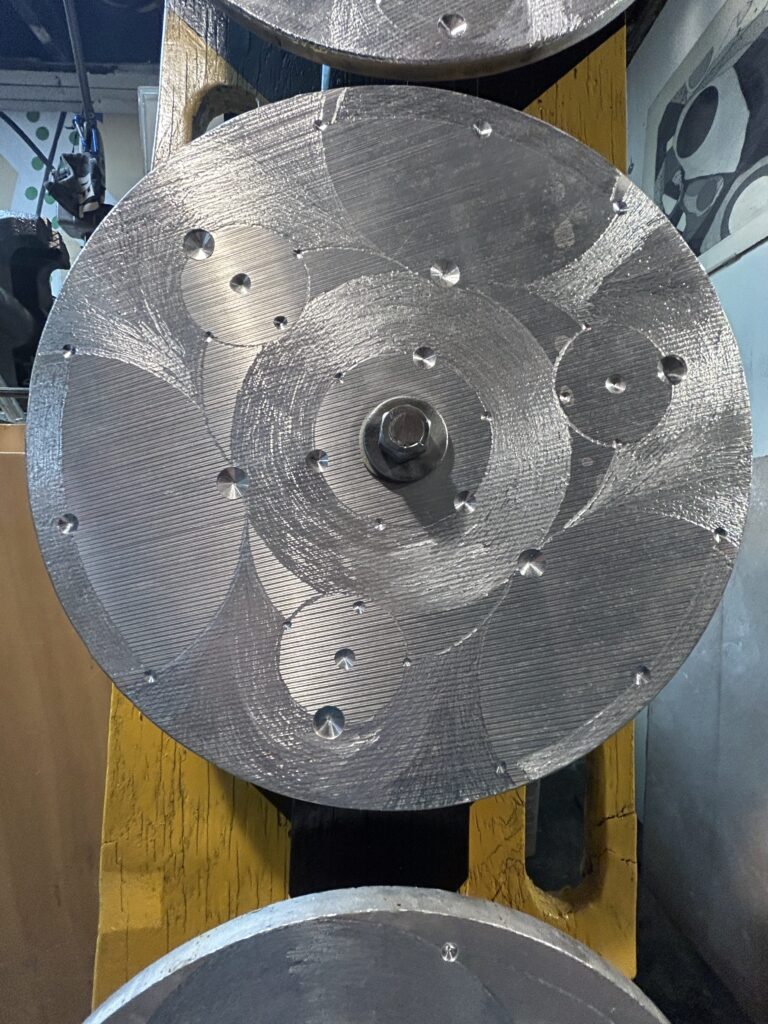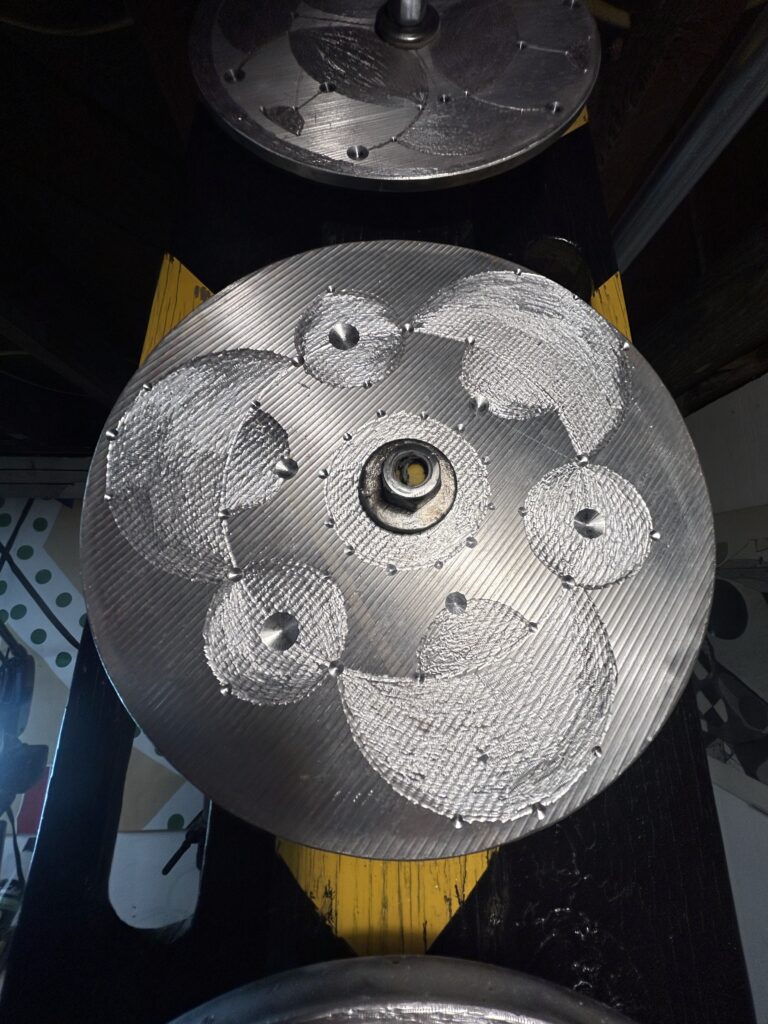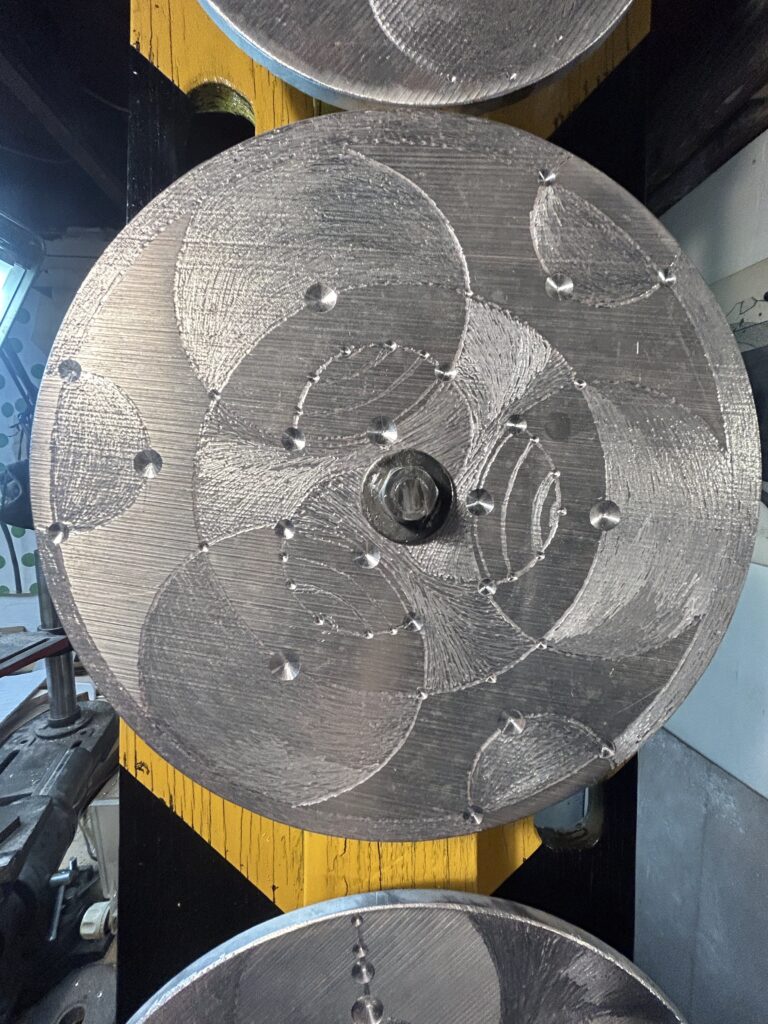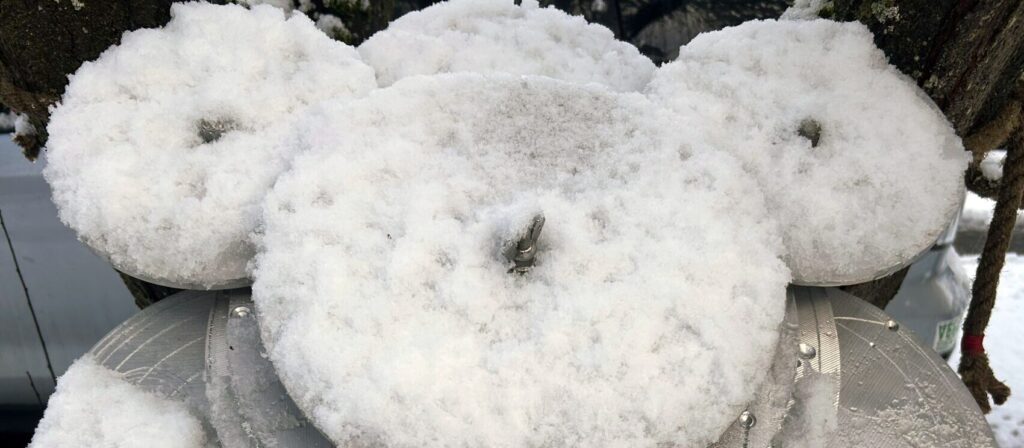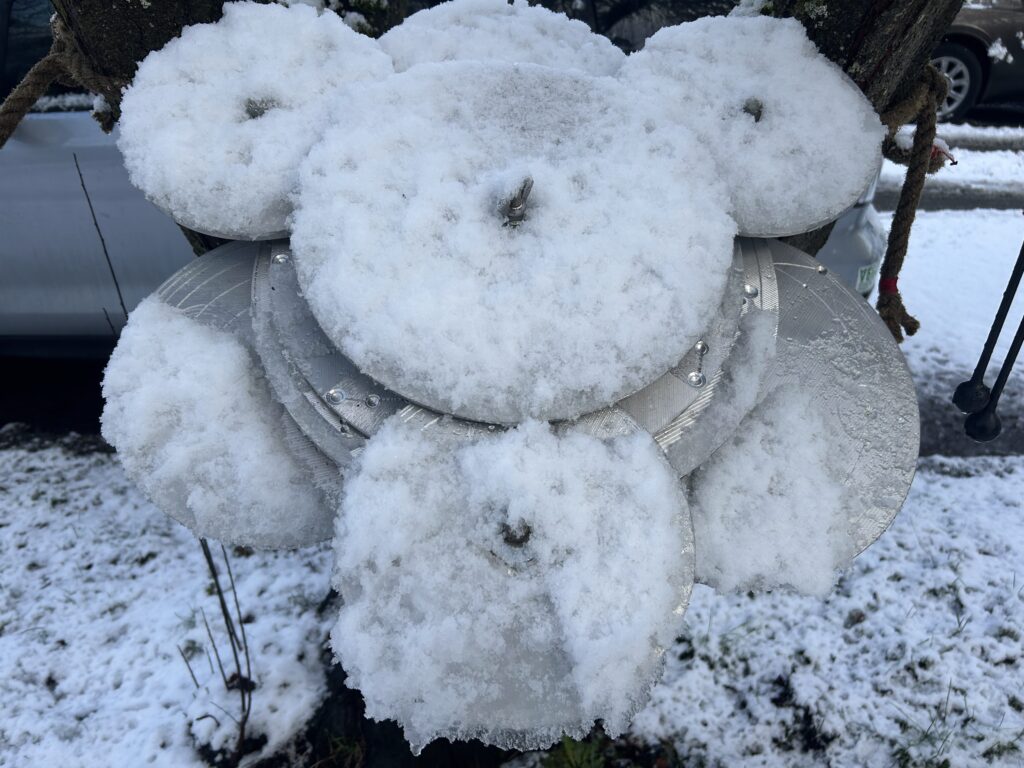
The trick with scrap-aluminum gongs is that you just can’t tune them.
So I built this basic array by ear (back when I decommissioned XyloVan), choosing disc gongs that would resonate well together.
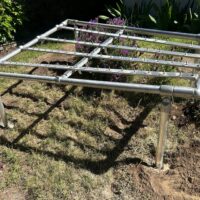
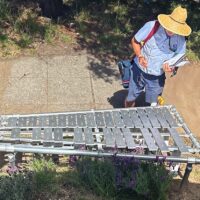
This past month, I upgraded the whole thing to get it ready for visitors to Seacompression to bang on and enjoy.
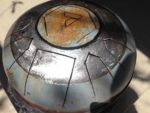
Weather had beaten the crap out of the backboard while it lived on our rooftop in Brooklyn (site of my many nighttime courtyard gong serenades), so I gave it a fun paint job.
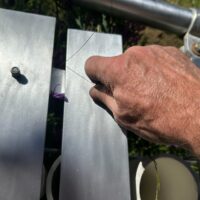
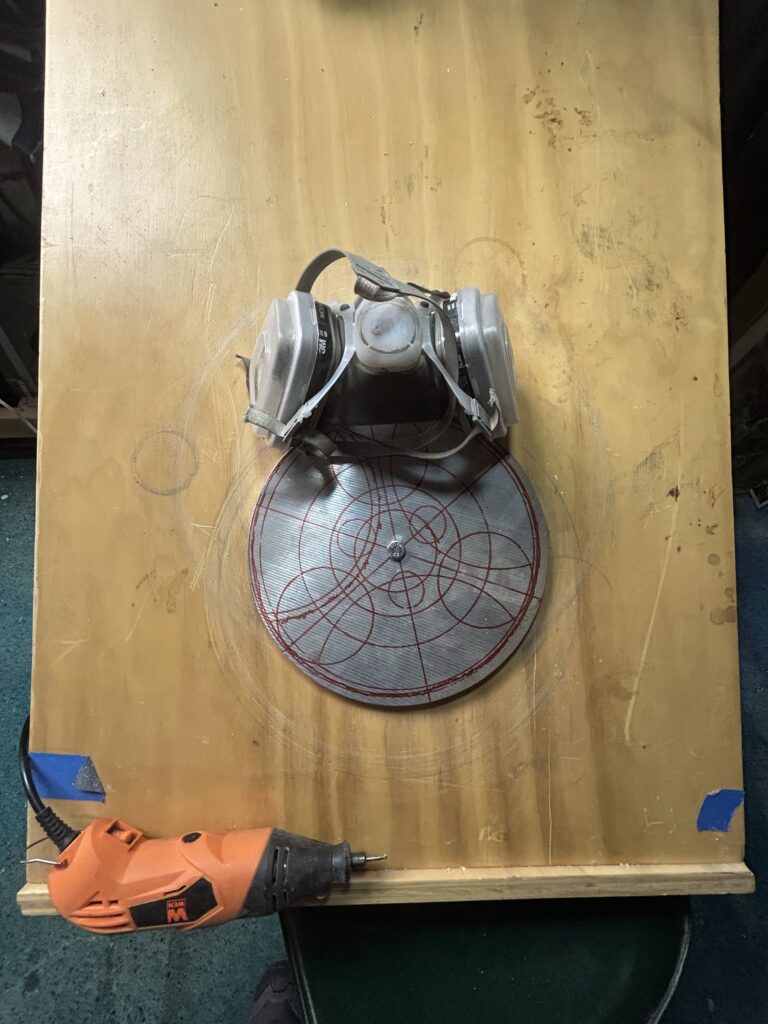
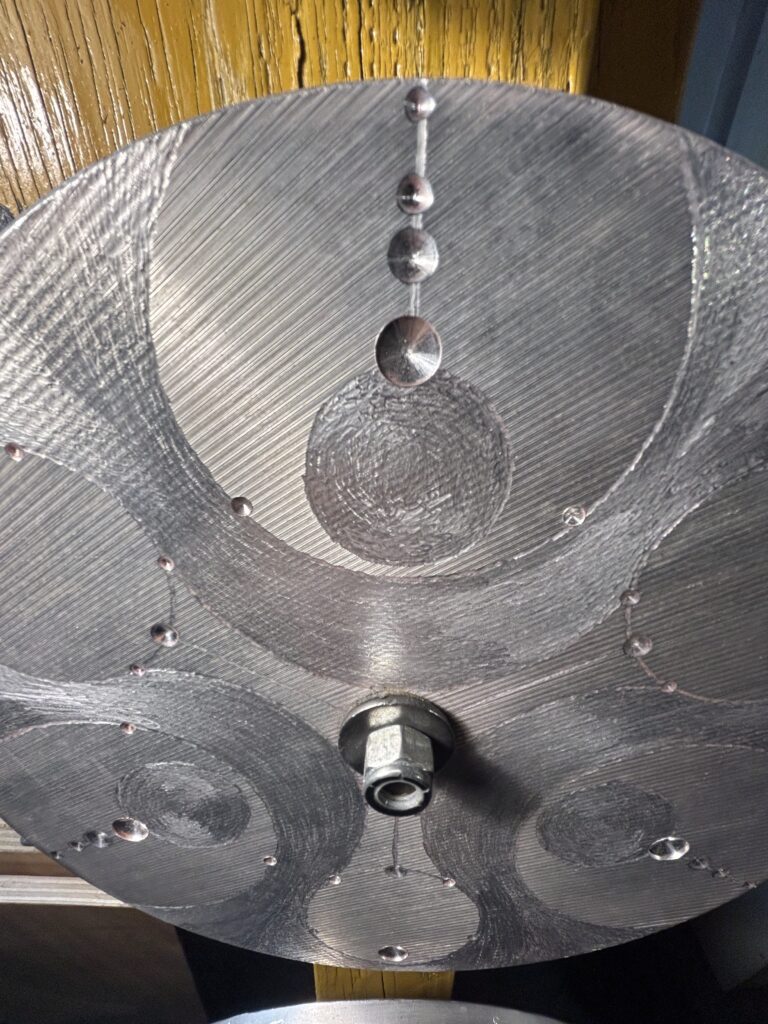
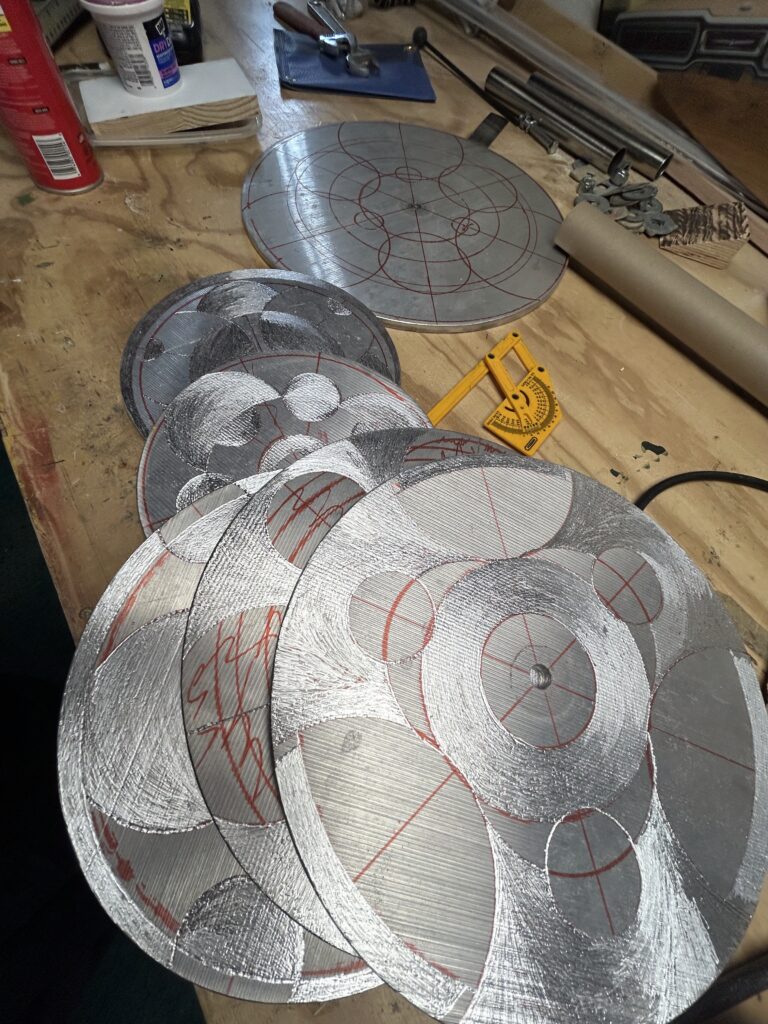
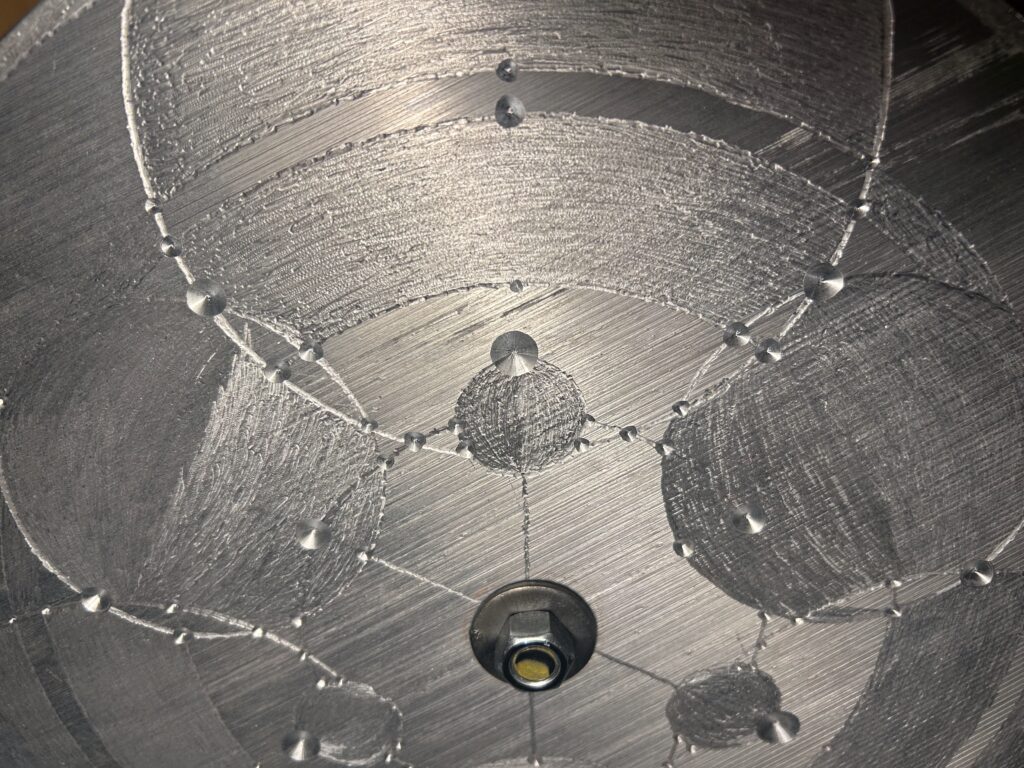
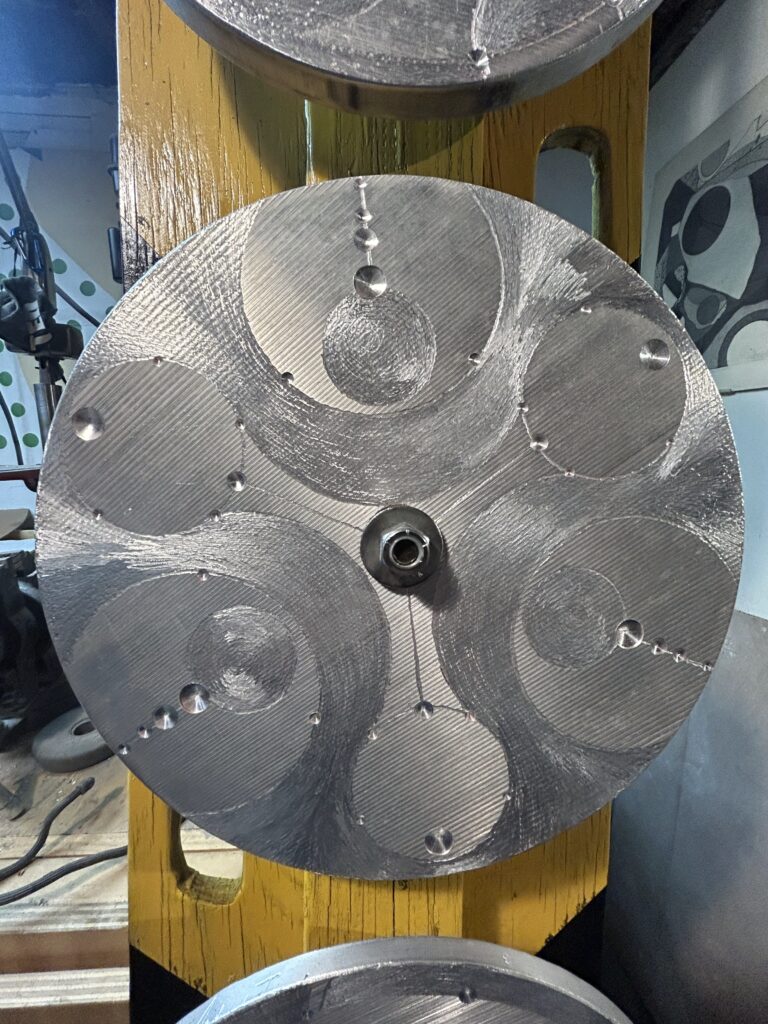
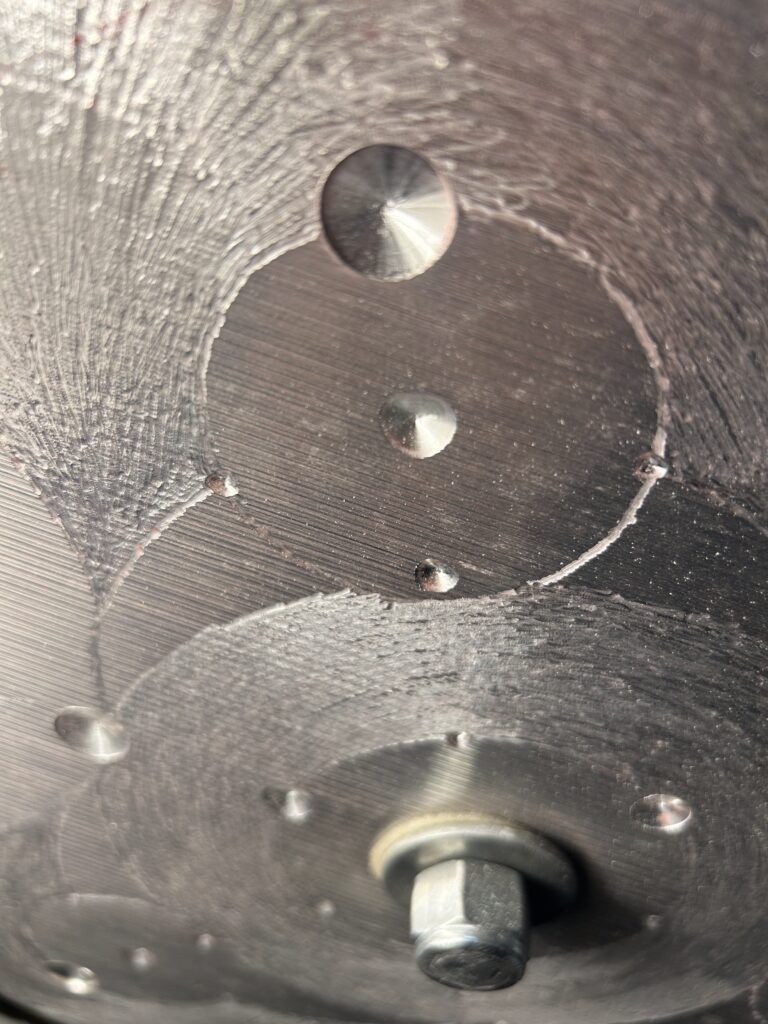
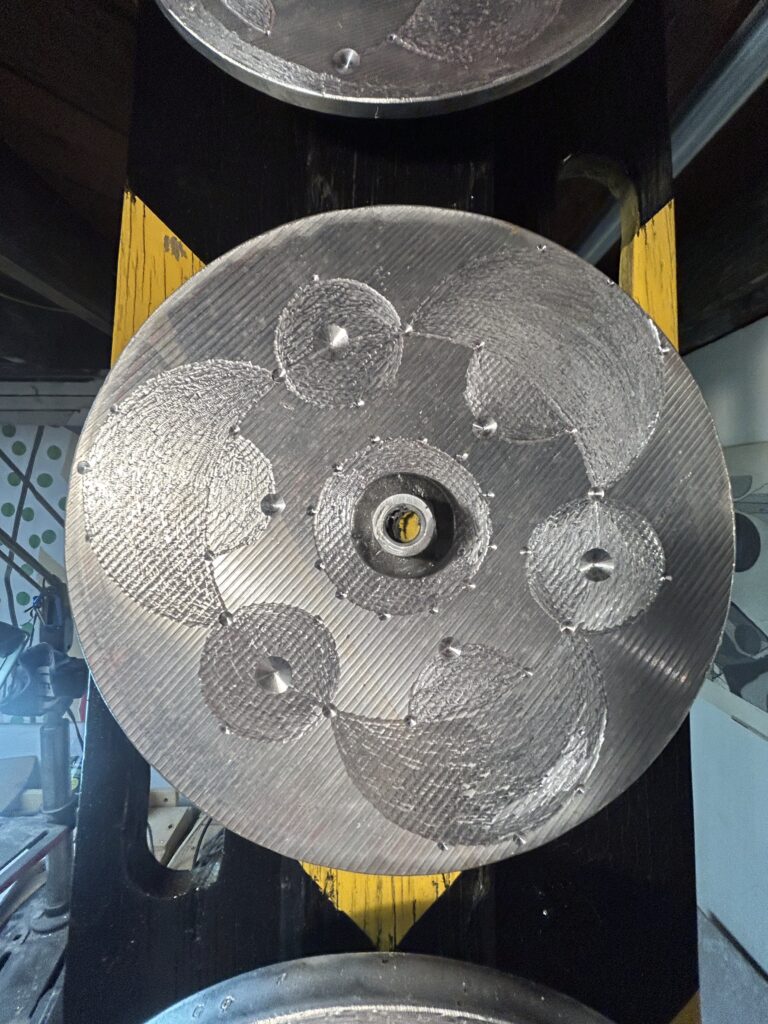
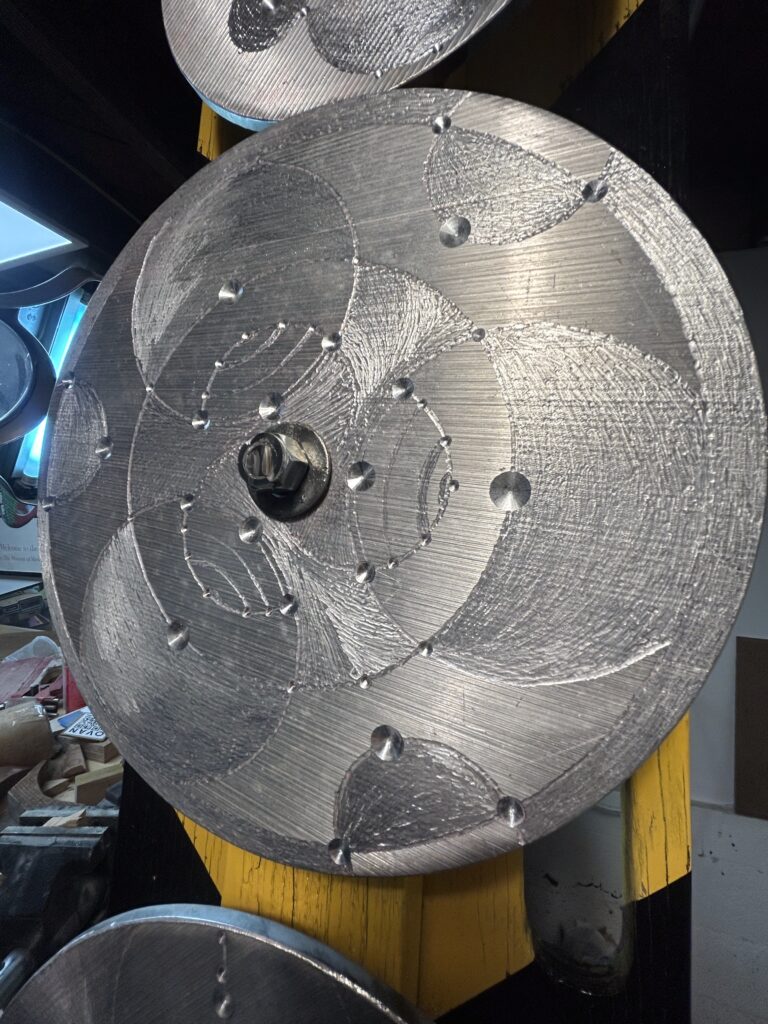
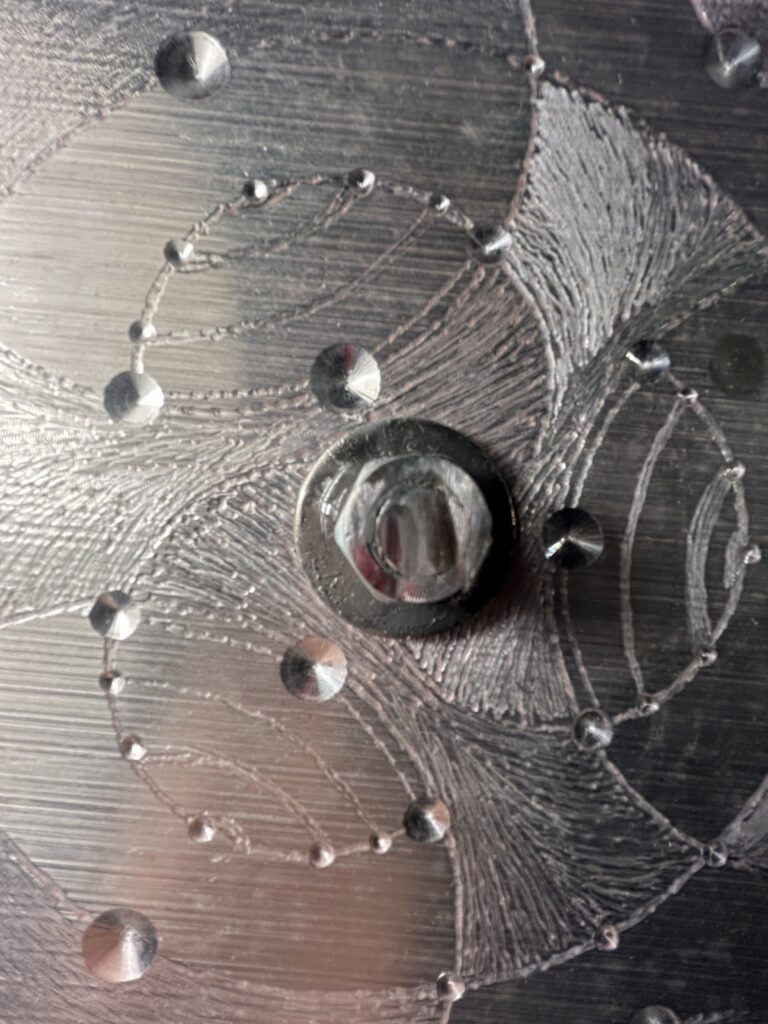
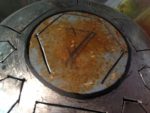
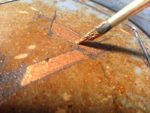
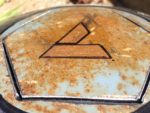
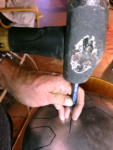
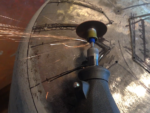
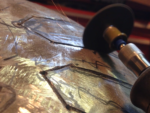
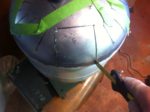
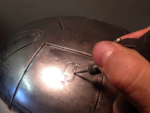
And I engraved all 7 of the otherwise dull chunks of metal, using a 1/16″ burr bit on my Dremel for the lines and shading, and then a series of drillbits for the points, all of which … took a few hours.
Long, long ago, in a city far, far away (2010, Los Angeles), I made this crazy thing with the help of my loving and endlessly tolerant family.
XyloVan – the only musical instrument I know of that got 8 miles a gallon downhill in a tailwind – played and ran for many years at Burning Man and various like-minded creative events and venues, and many thousands of people enjoyed playing on its instruments and generally making happy noise.
In 2019, with much excitement, we moved to New York City – which meant that, with much regret, I had to sell the vehicle, unmount all the instruments to put them into storage, and move on to a new phase in our lives together.
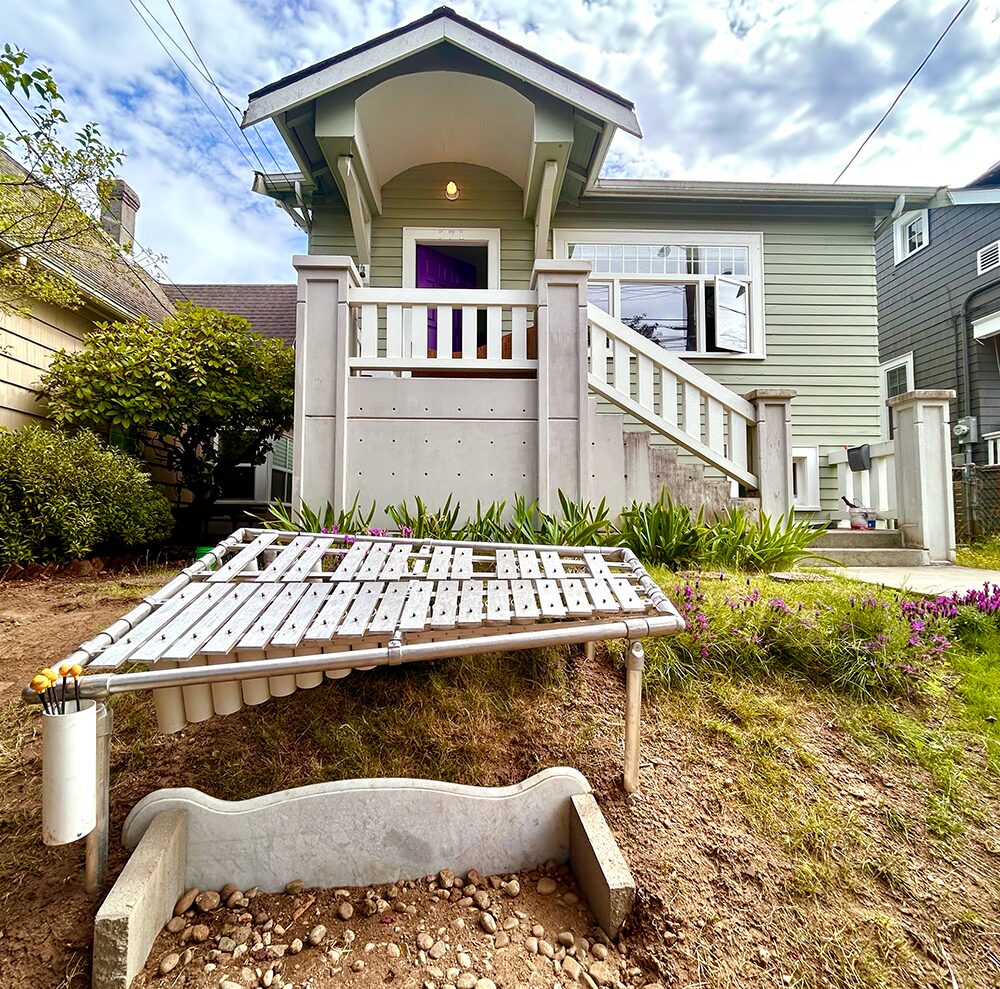
We moved to Seattle in 2021 and this year, I finally got tired of tripping over this set of scrap-aluminum gongs (which I had stripped off of the van and rearranged in this array four years earlier in a fit of creative frustration in NYC) and decided to share them with the world again.
So here they are, mounted on one of our flowering plum trees (carefully, so as not to hurt the tree!)
We’re also planning to bring the xylophones up from storage in L.A. and mount them in the front yard for all to play. In the meantime, you’re invited to come bang on the gongs. Please enjoy.
UPDATE: Confidential to the wonderful stranger who ding-dong-ditched a pair of Sonor percussion mallets on our front porch this week:
Thank you! I’ll rig them up and put them out so people can play together. Next time you’re around, please say hi!
This is a long way from xylophones and propane-tank drums, but I’ve really enjoyed building cajóns and – for the first time – a marimbula.
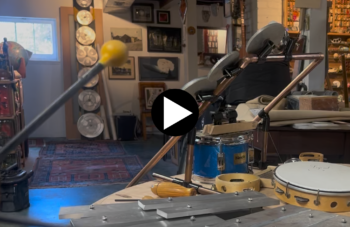
Quick demo and walkaround
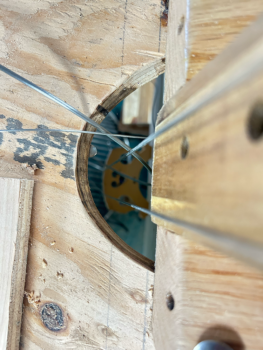
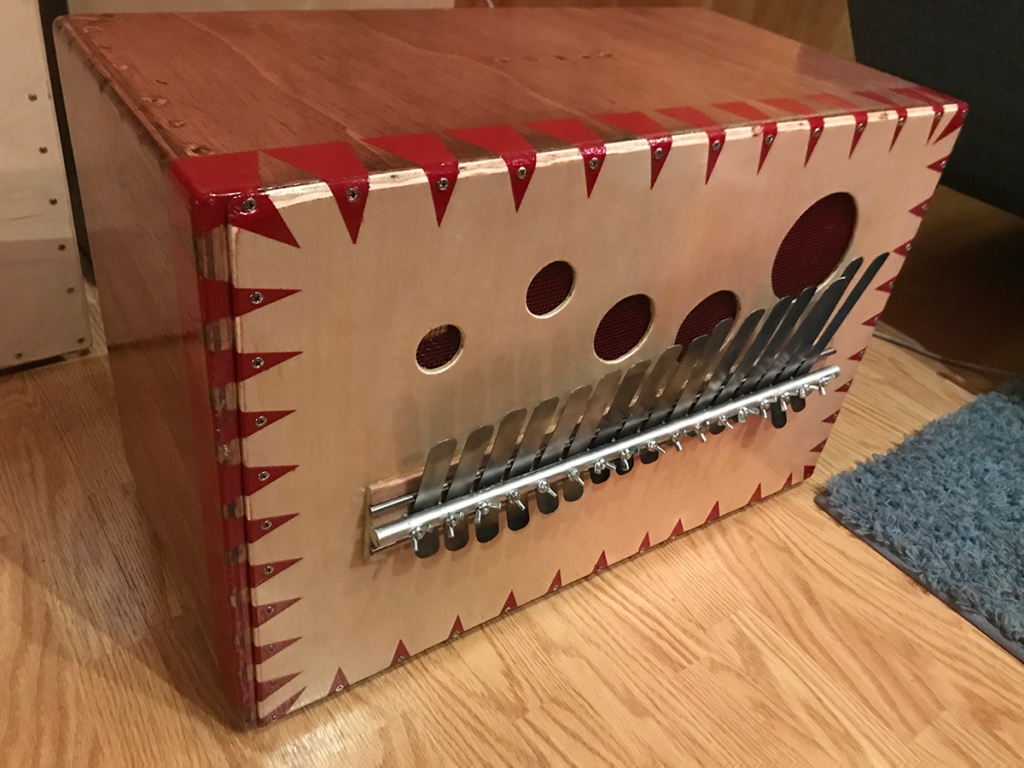
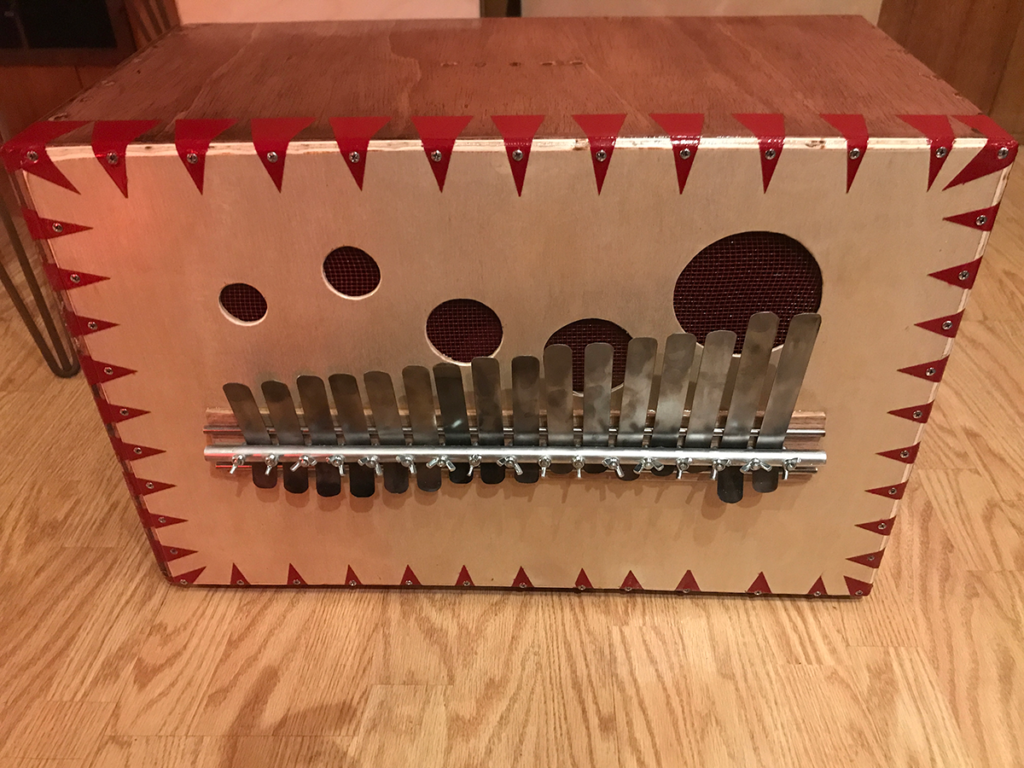
The marimbula is a Caribbean instrument, descended from the African kalimba, and generally functions as a bass. As you’ll see in the video at the bottom of the post, I first experimented with a 6-key marimbula built onto the back of one of my cajons, just to figure out the basics of construction.
This one is a 16-key marimbula – which I’ve decided has about three too many bottom-end keys and perhaps one too many high-end keys, as the sound quality falls off quite a bit at the ends of its scale. Next, I might try building one like a piano keyboard (with two layers of keys in white and black) centered in the middle of this scale.
The tuning has been kinda challenging – I finally settled on D – but I’m tuning it slowly by ear because the digital tuning apps can’t handle all the overtones it puts out. Anyway, it’s a helluva lot of fun to play – particularly on a nice, resonant wood floor – because it’s easy to play, and the notes send vibrations through your butt and up your spine. I take great satisfaction in building instruments that create physical joy along with pleasant music.
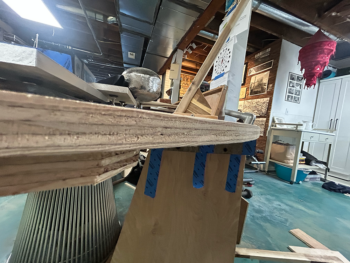
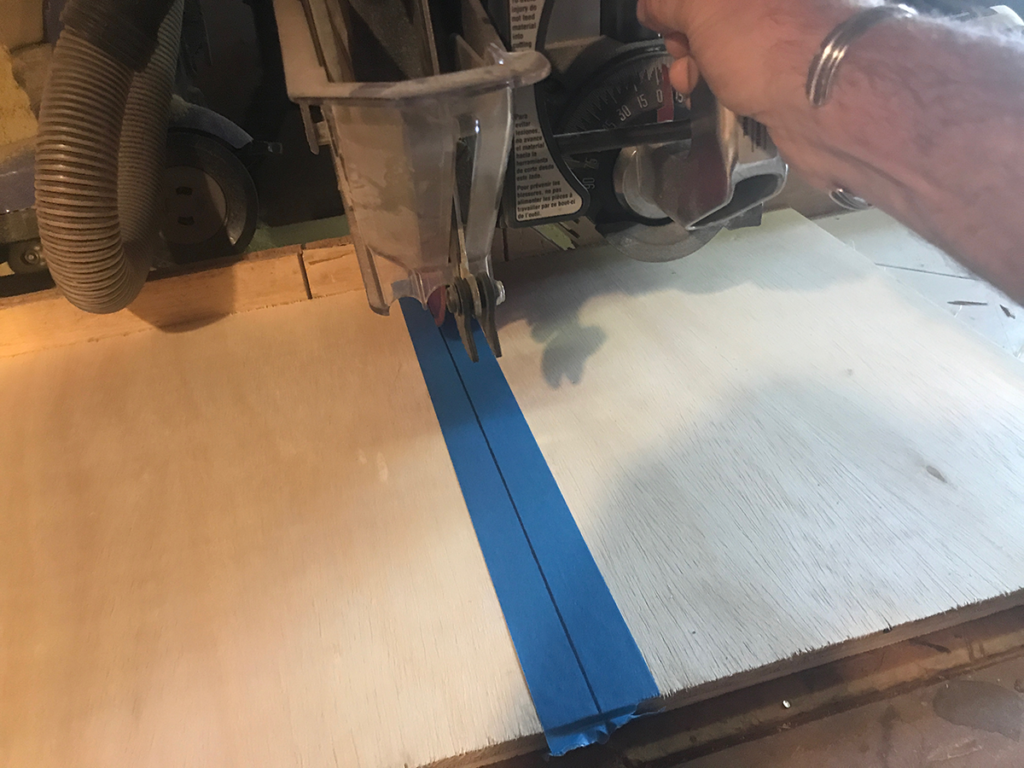
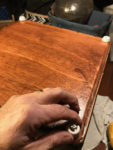
I use white birch finish plywood. I cut the box pieces through masking tape, which makes for clean cuts by keeping the blade from shattering the delicate veneer.
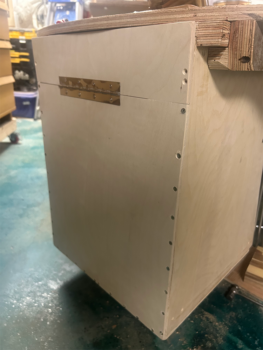
Dry-fit the pieces, then drill for pegs. I cut my own from 5/16″ dowels, which makes for cleaner joins than you get with factory-made pegs.
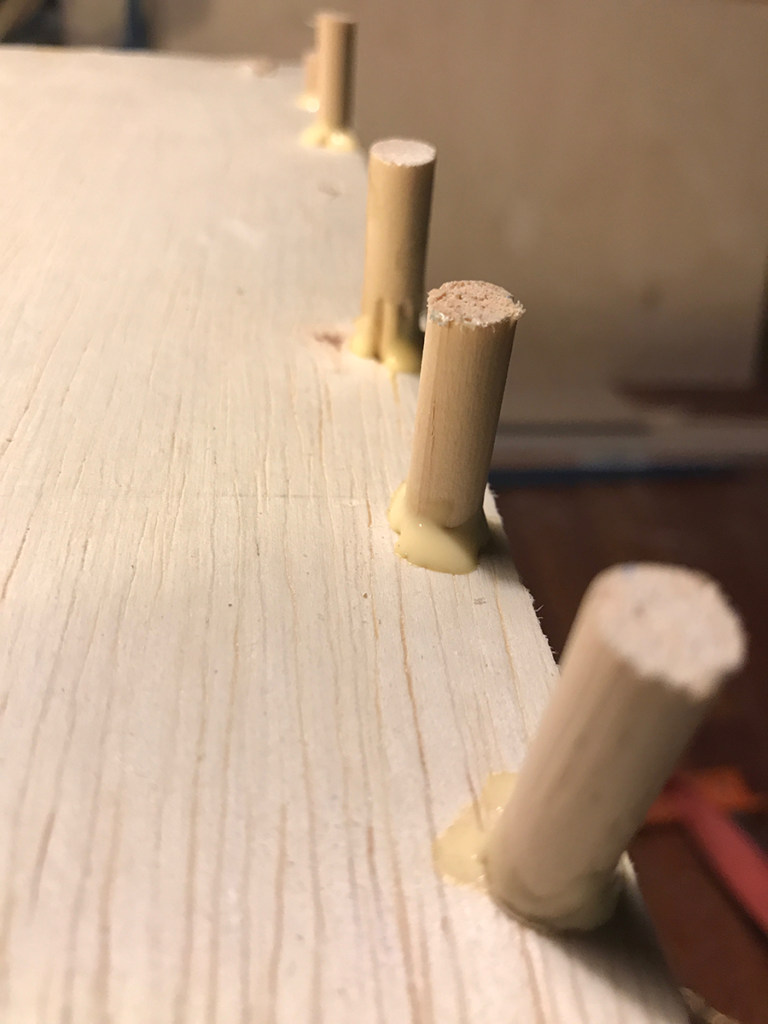
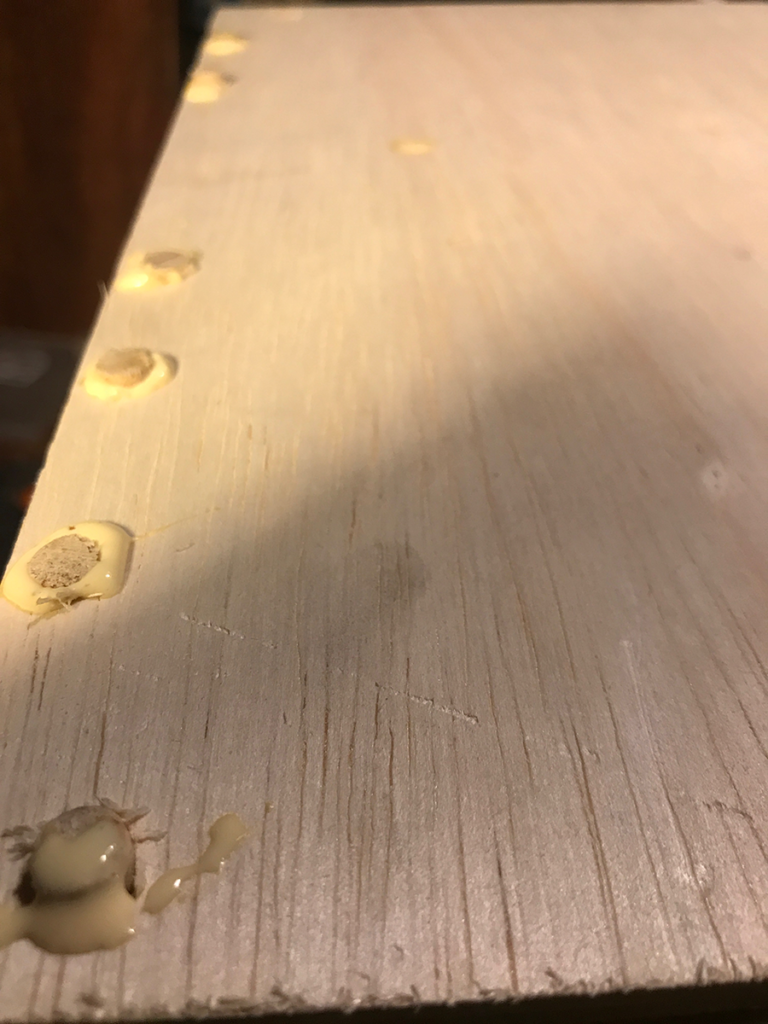
Glue all the plywood points, then add some glue to the peg holes …
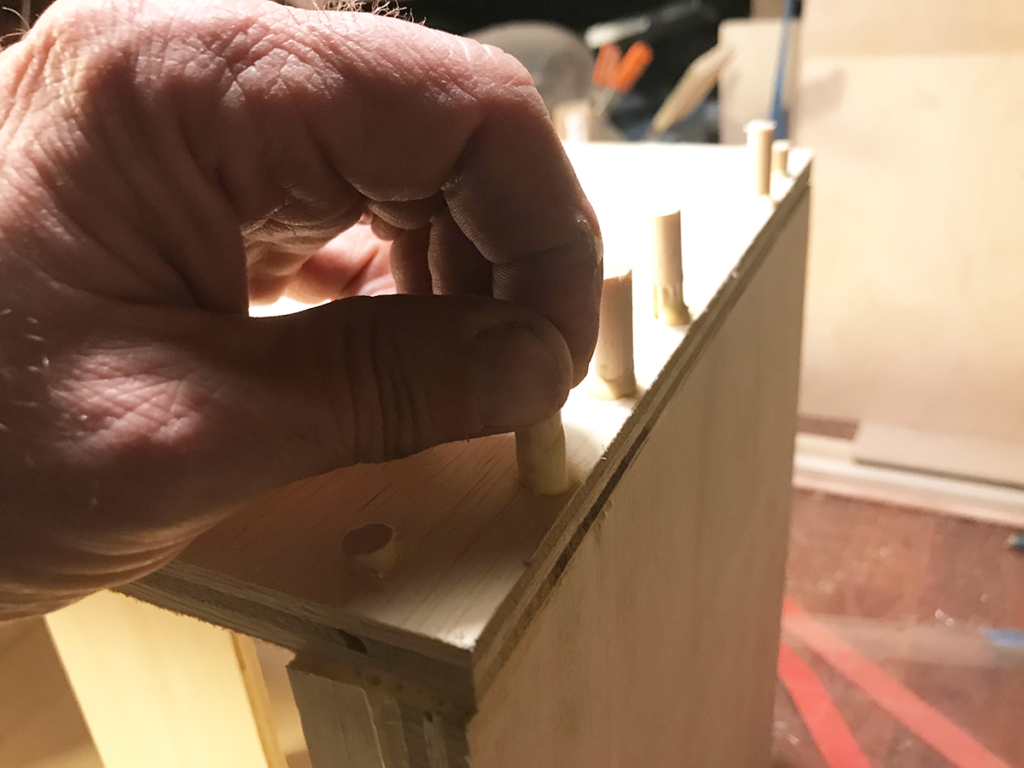
… and drive them all in. I’ll sand off the excess to make them flush with the surface when everything is dried.
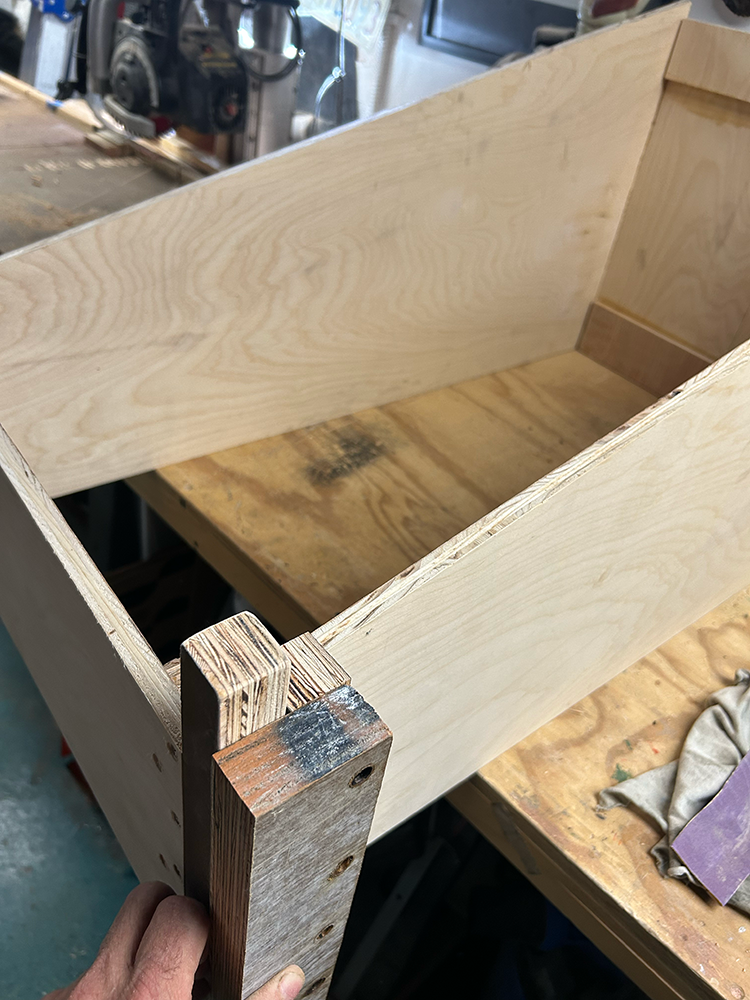
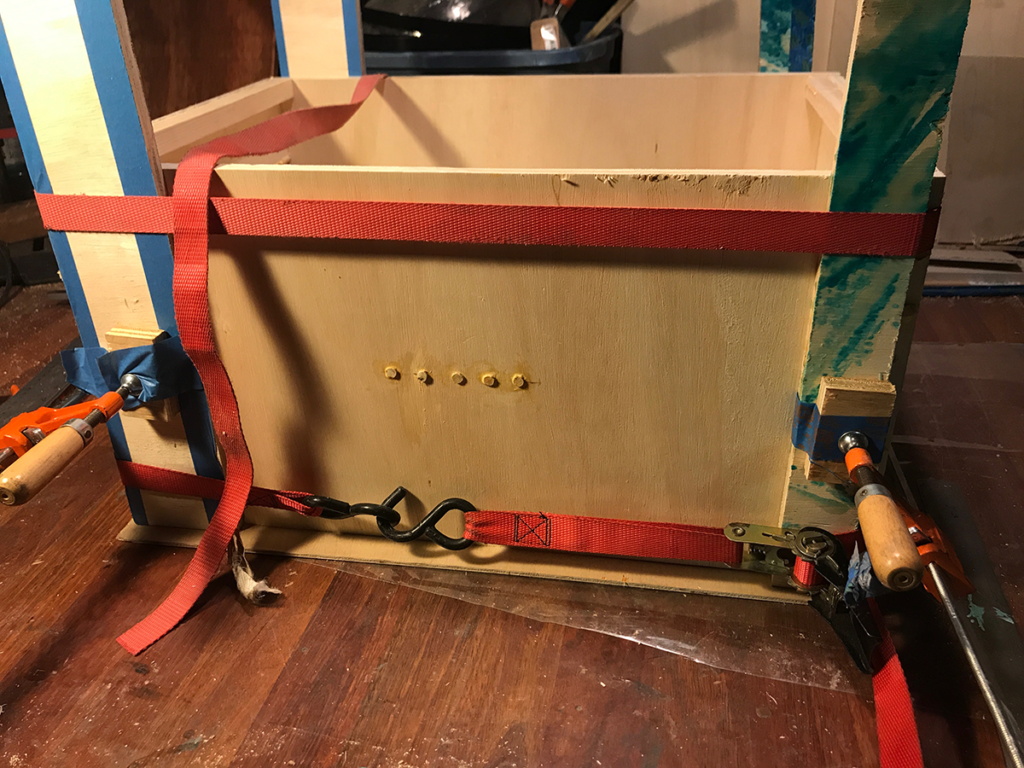
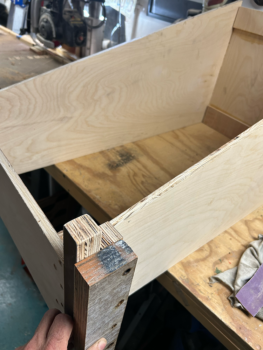
Being short on (pricey) carpenter’s bar clamps, I use the two I have, then augment with ratchet straps. The vertical chunks of scrap plywood keep the straps from damaging the veneer.
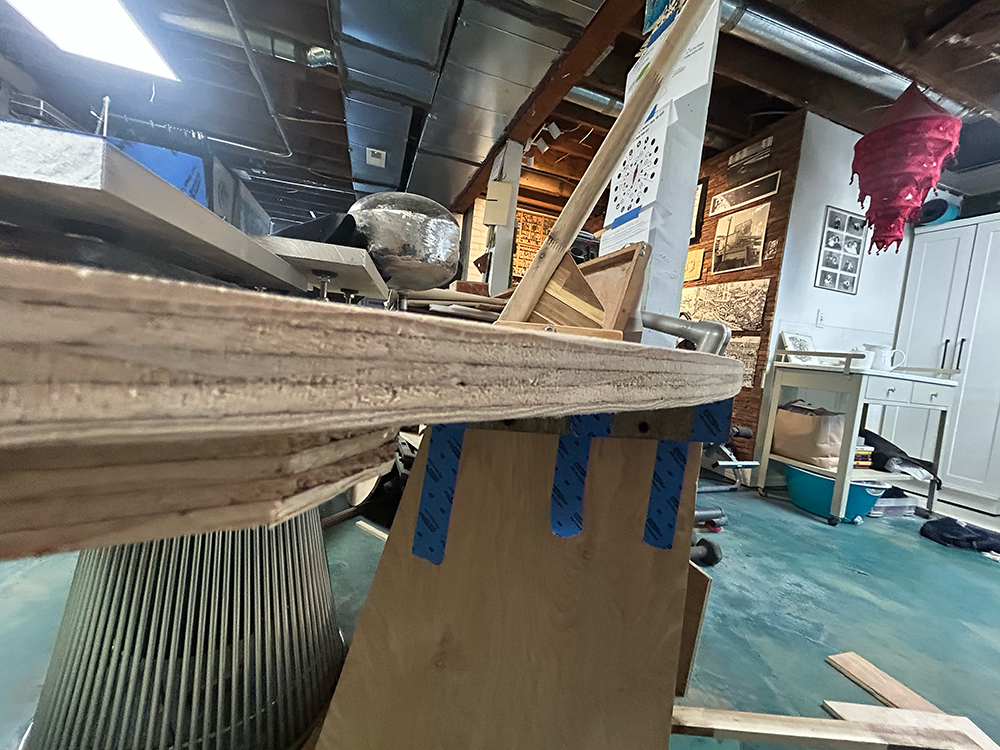
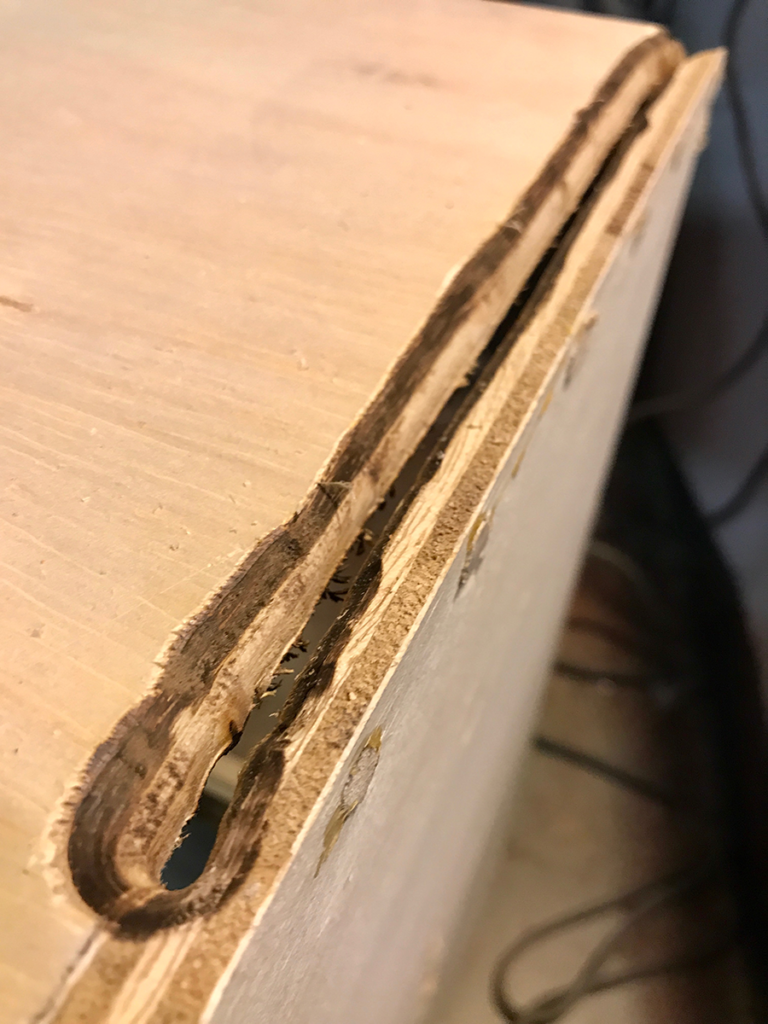
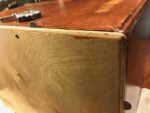
This is deeply embarrassing as well as horrible-looking: I failed t set up the router correctly, then dragged it straight through the face of the box instead of nicely rounding the corners. After much cursing and shouting, I just capped the whole gashed end with another layer of plywood.
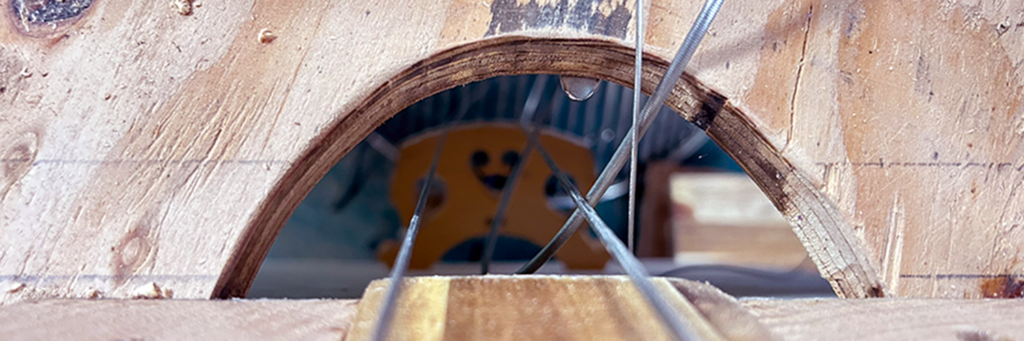
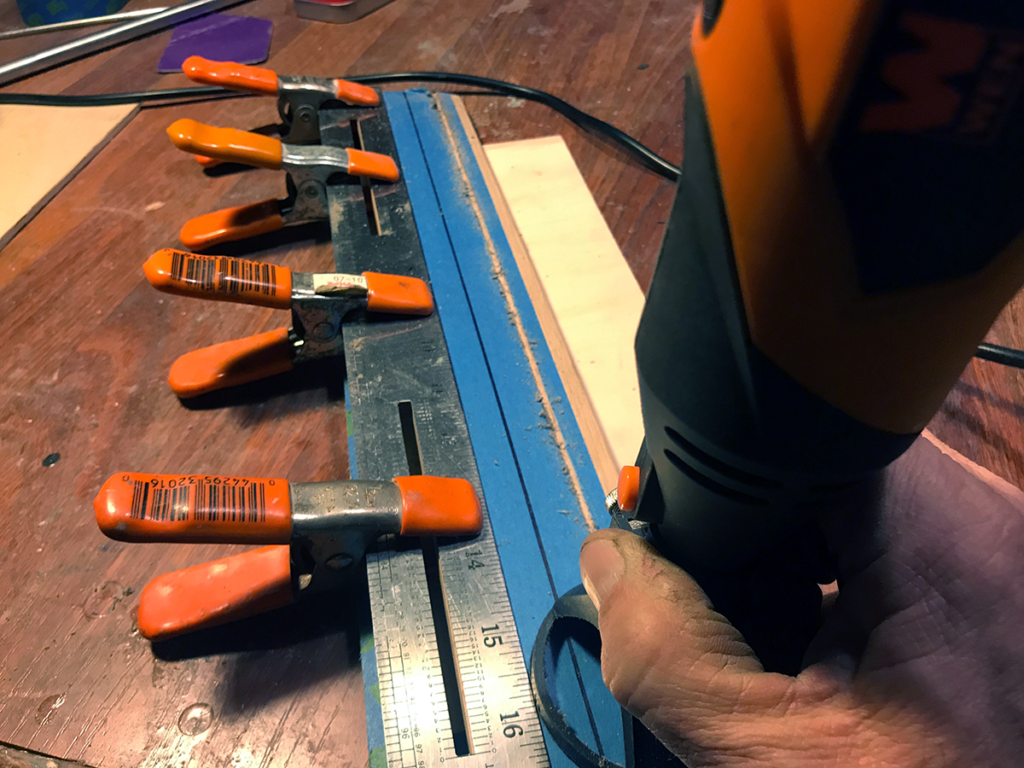
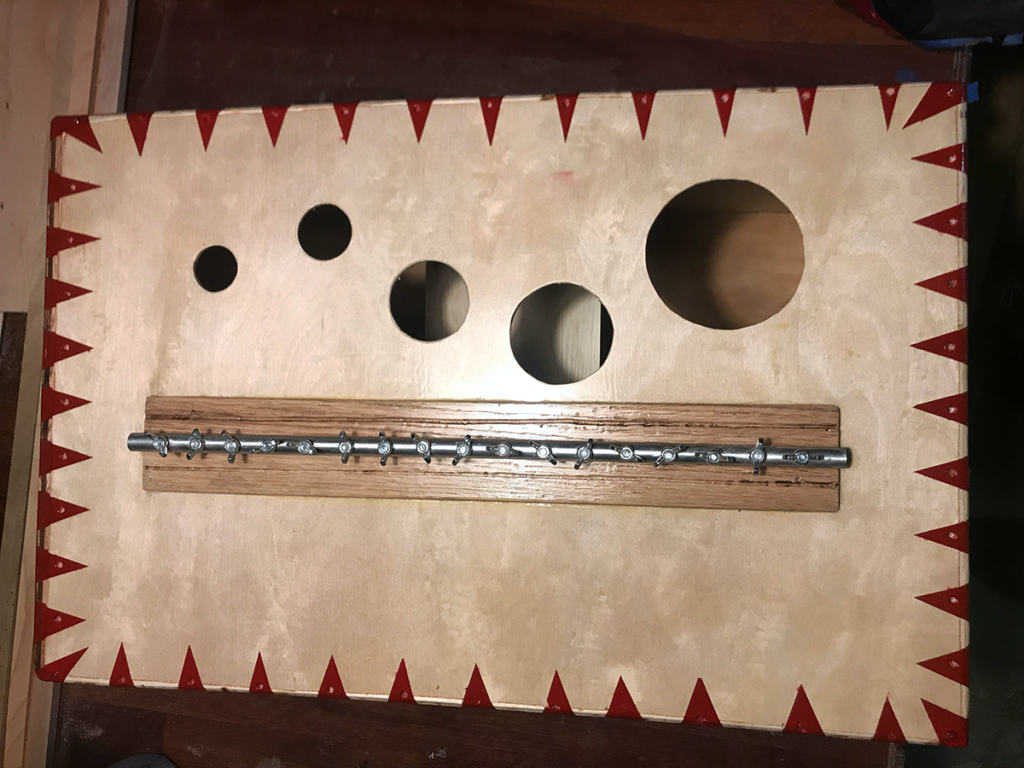
The bridge is a strip of red oak. I clamped a ruler to it to guide the router, which I used to cut a groove for the bridge’s nut bars (terminology?) to sit in.
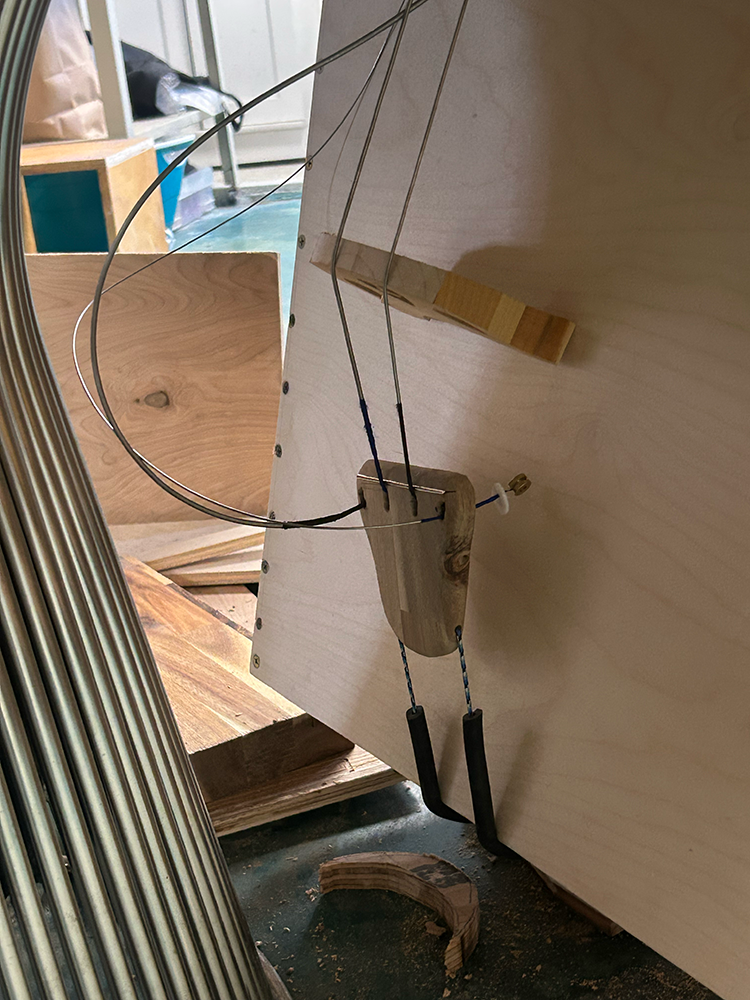
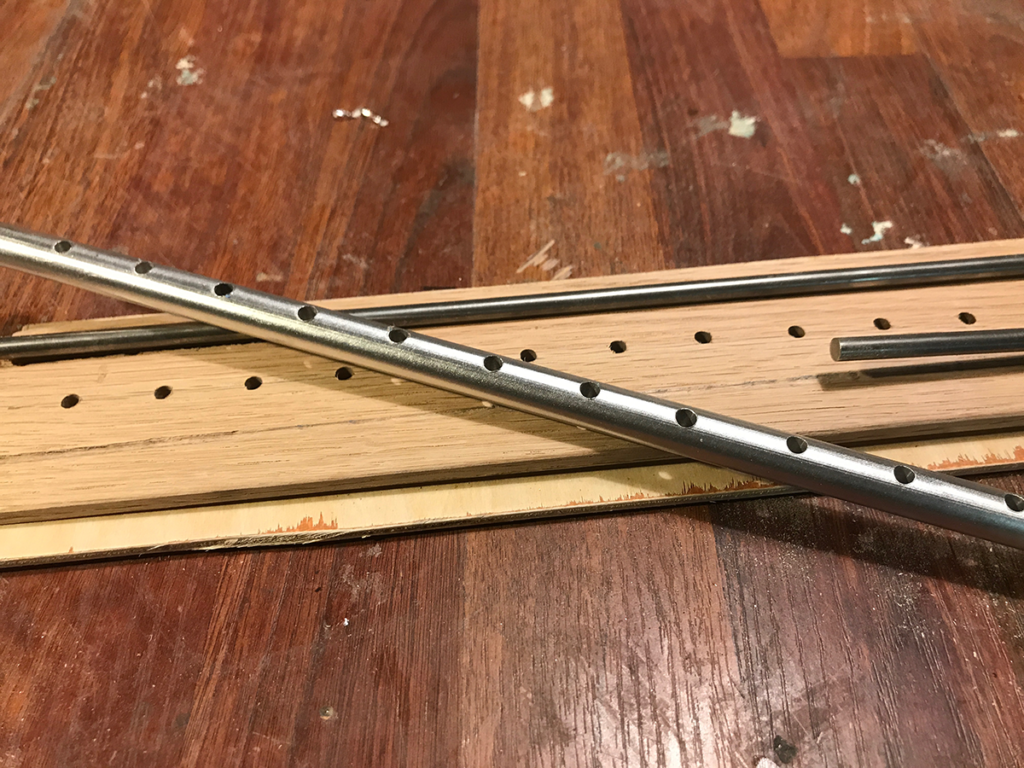
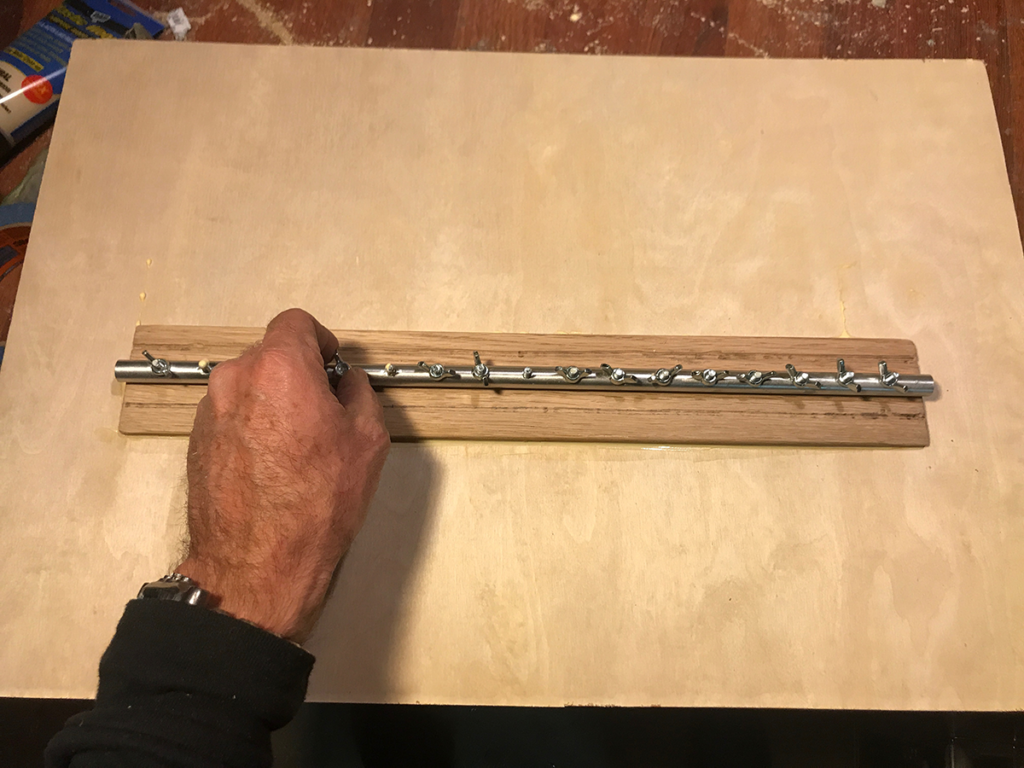
The completed bridge pieces – red oak, stainless-steel nut bars (which the keys will rest on) and a carefully-drilled-out rod of aluminum for the bridge, which will clamp the keys down to the nut bars.
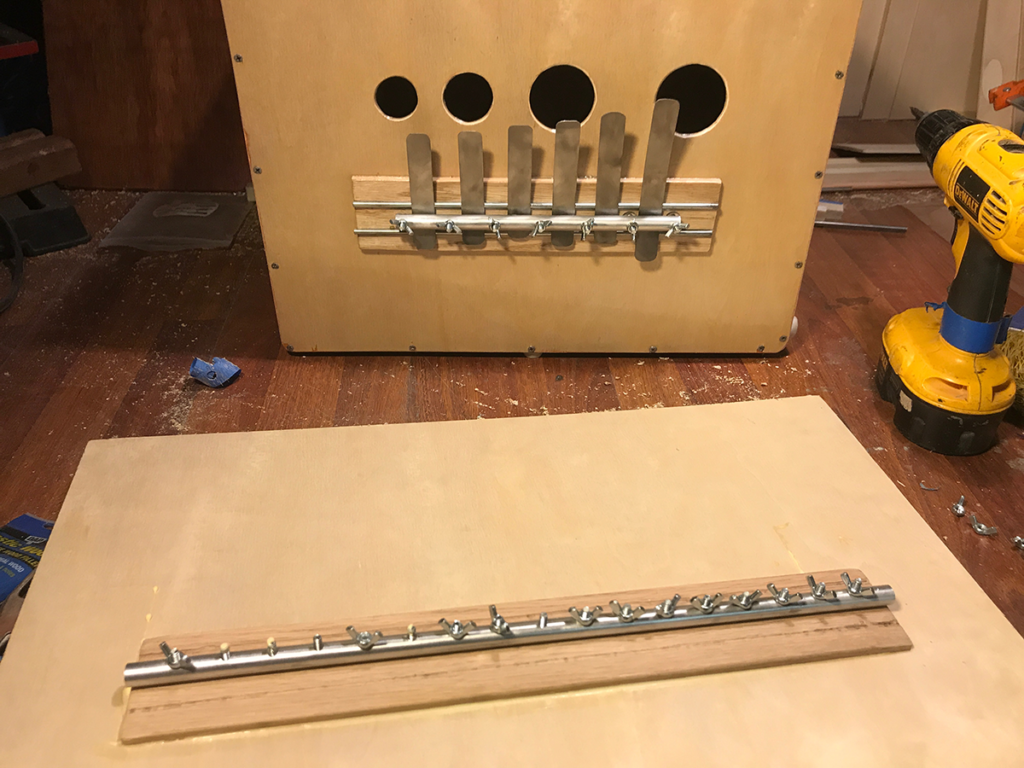
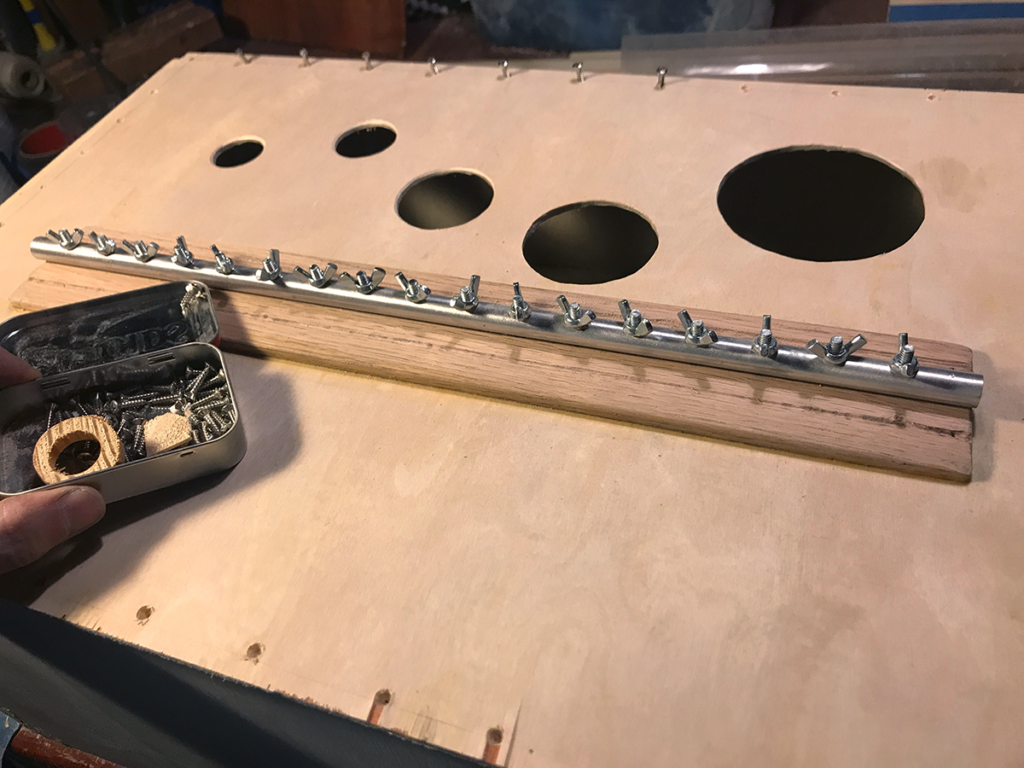
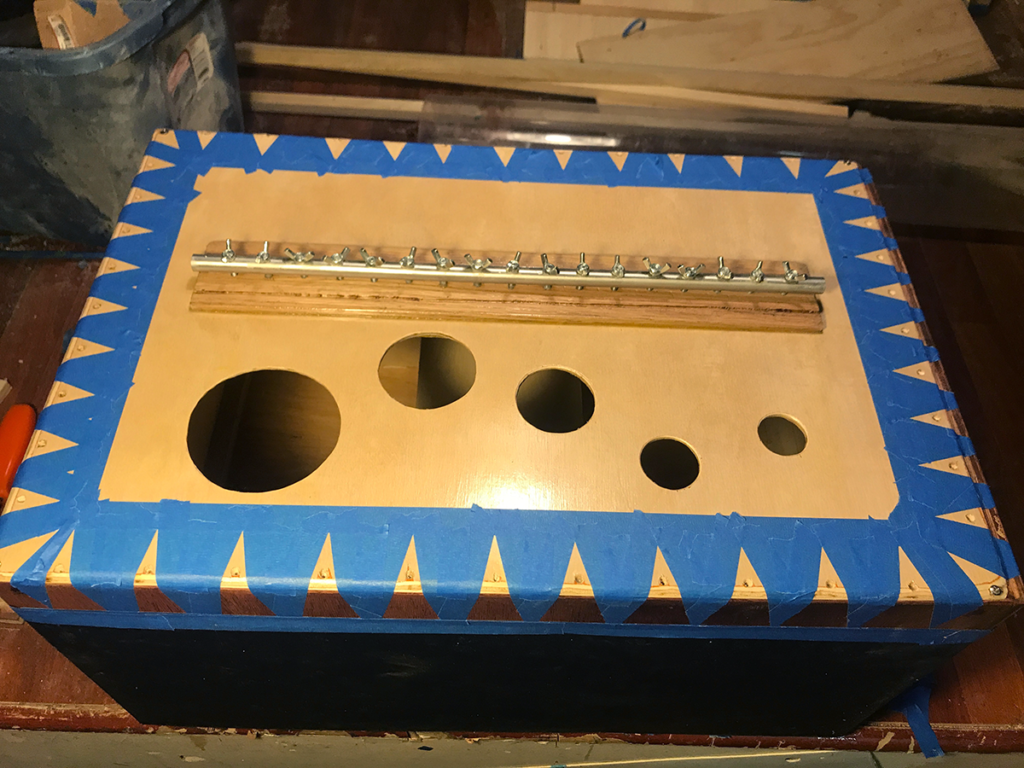
I cut a piece of 1/8-inch birch ply for the face, then drilled it out and mounted the bridge assembly (traditionally called the harp) to it with machine screws and wing nuts.
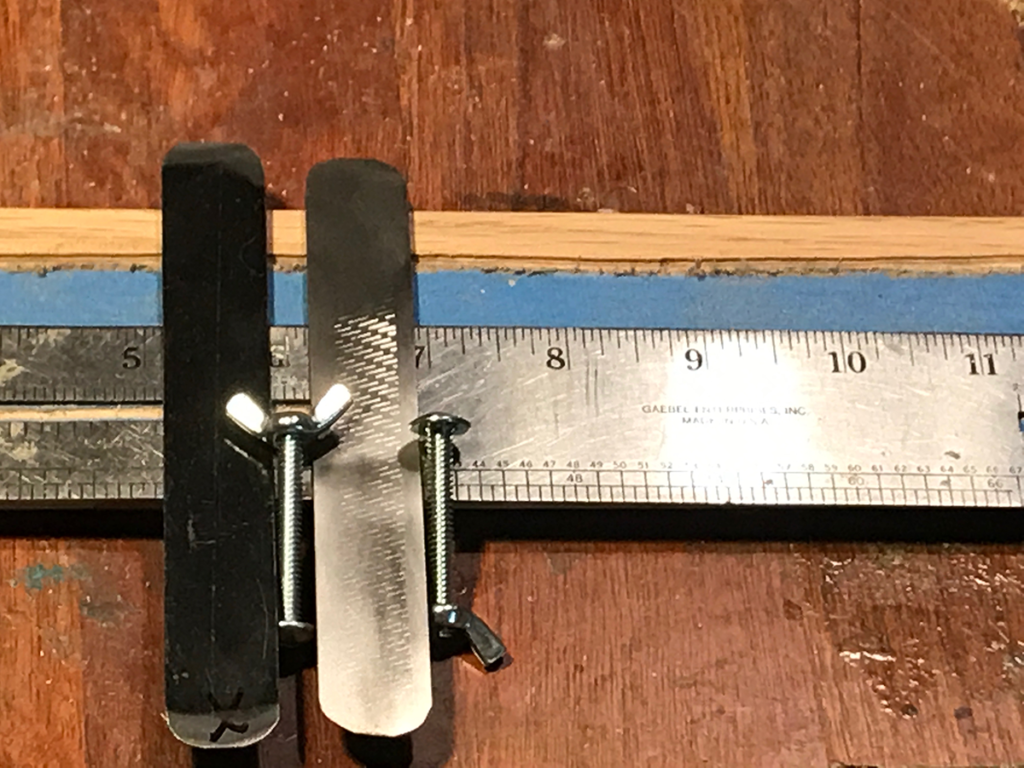
Here’s a comparison of the 16-note bridge with the 6-note bridge I mounted on the cajon that I used as a test mule.
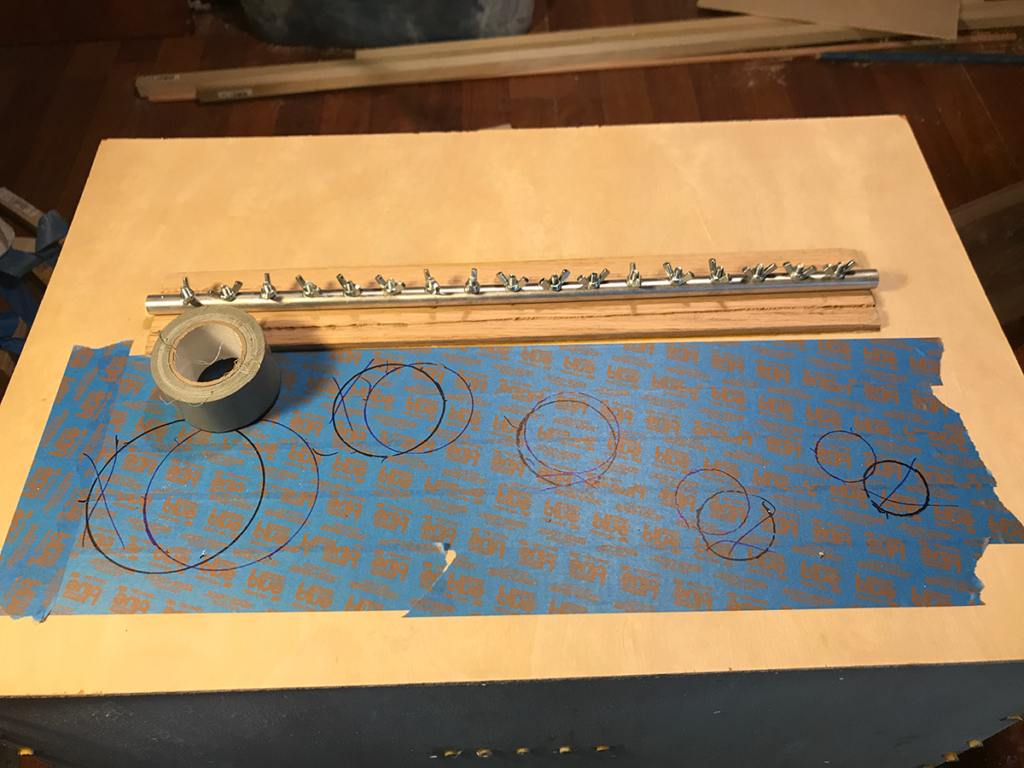
After masking the face to prevent splintering, I laid out the sound holes, then cut them with a keyhole saw (for the smaller ones) and a roto-zip bit on my knockoff Dremel for the two largest ones.
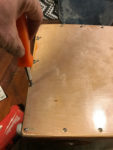
Next, I drilled all the holes for the screws – way too many, it occurred to me way too late, but the large number of screws actually wound up helping the overall visual design.
I masked off the edge for painting.
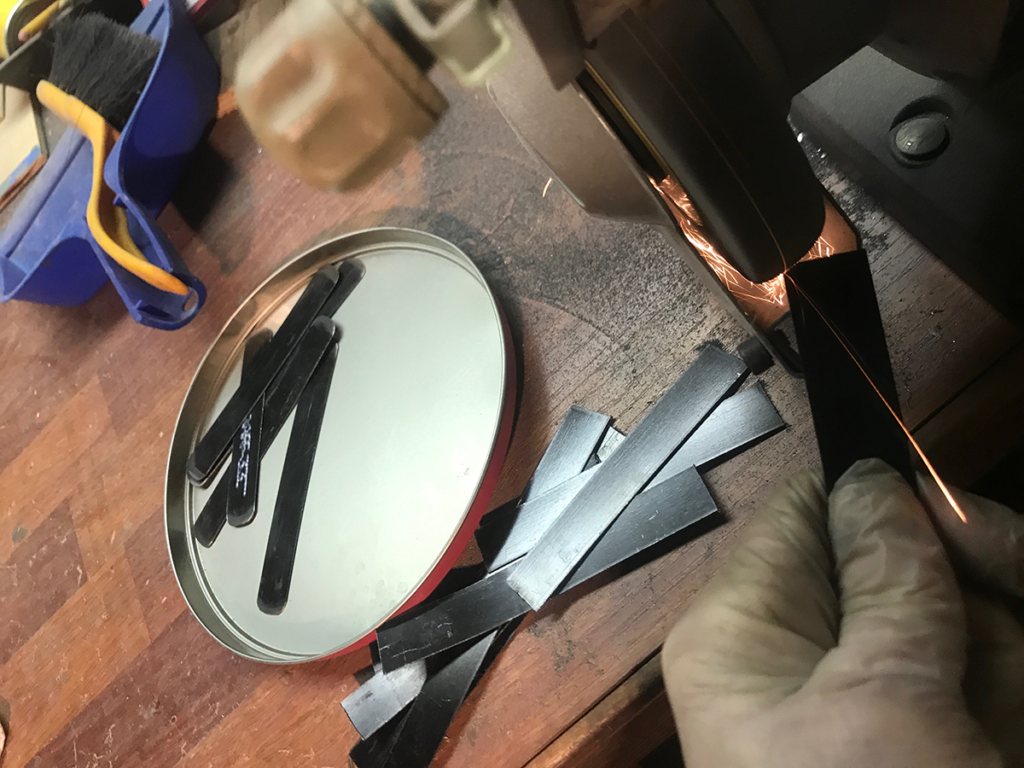
Earlier, I cut the shipping strap chunks into rough lengths with an angle-grinder, then ground the corners round …
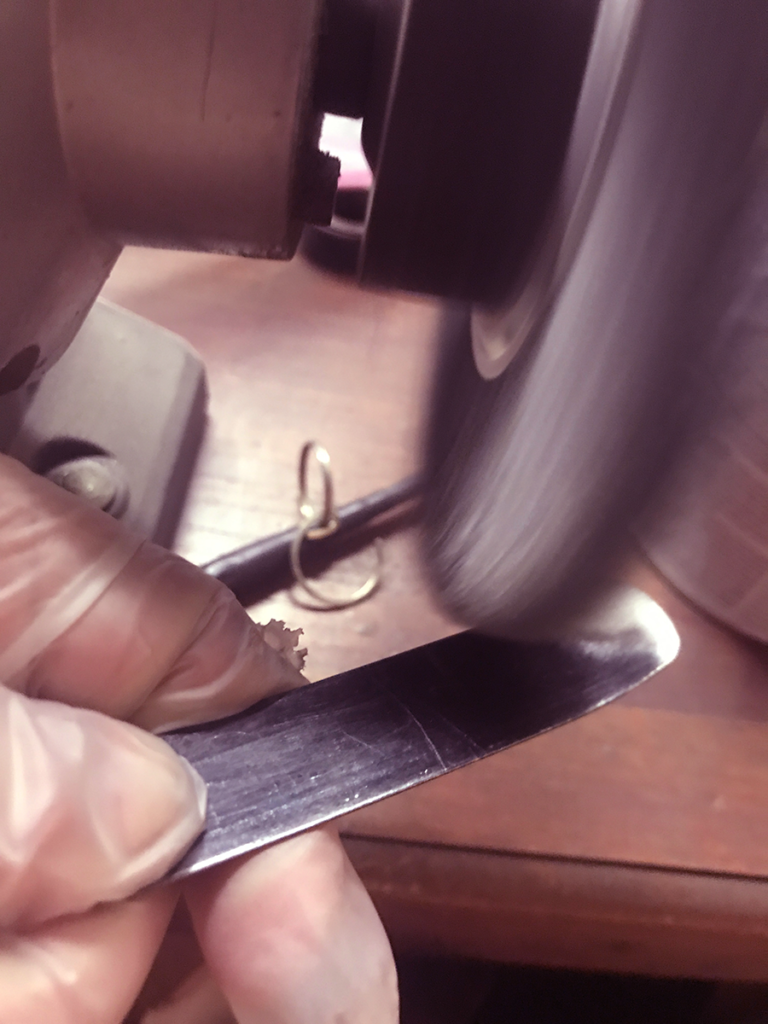
and smoothed them with a wire wheel.
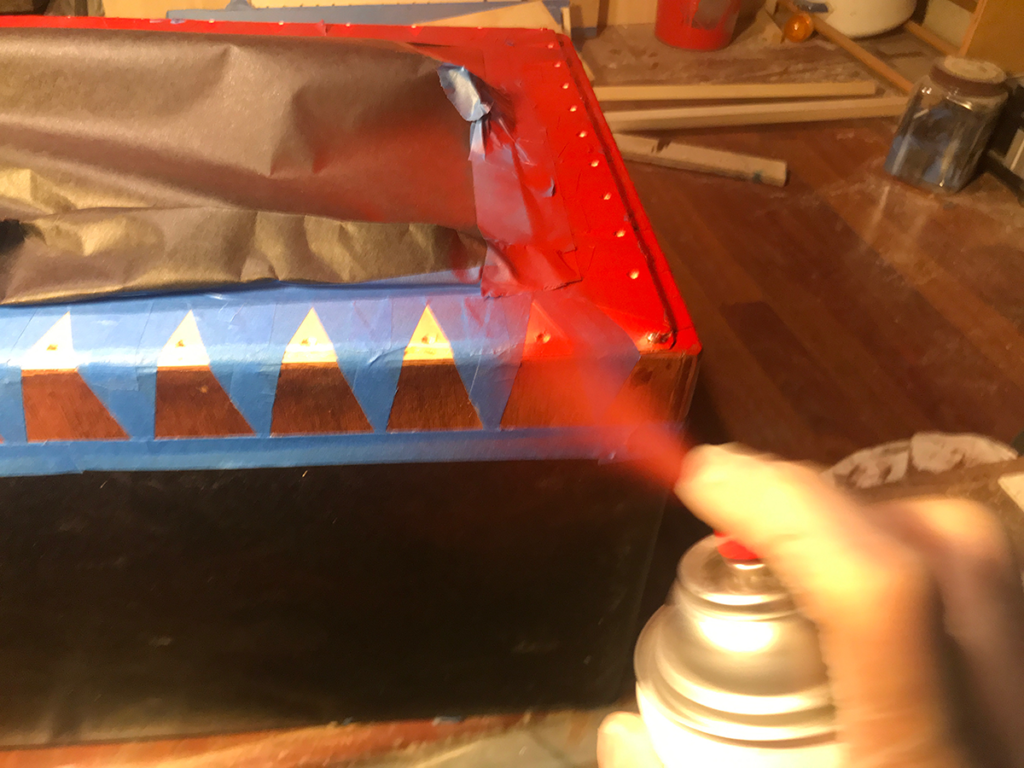
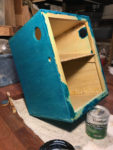
Shot the masked instrument body with red enamel (a favorite)
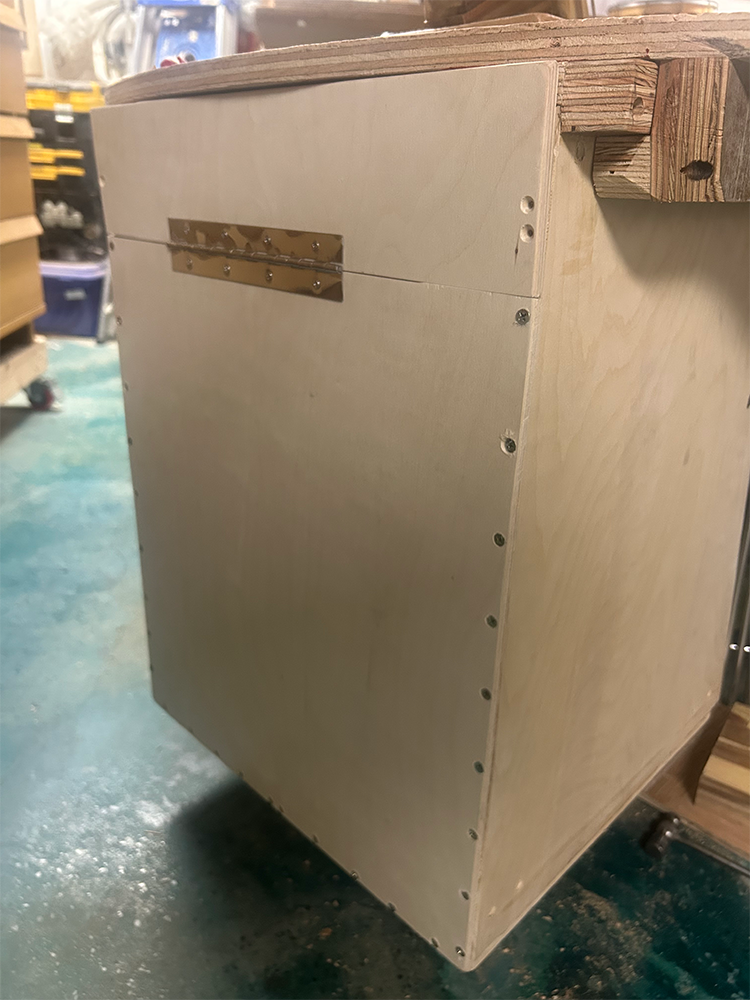
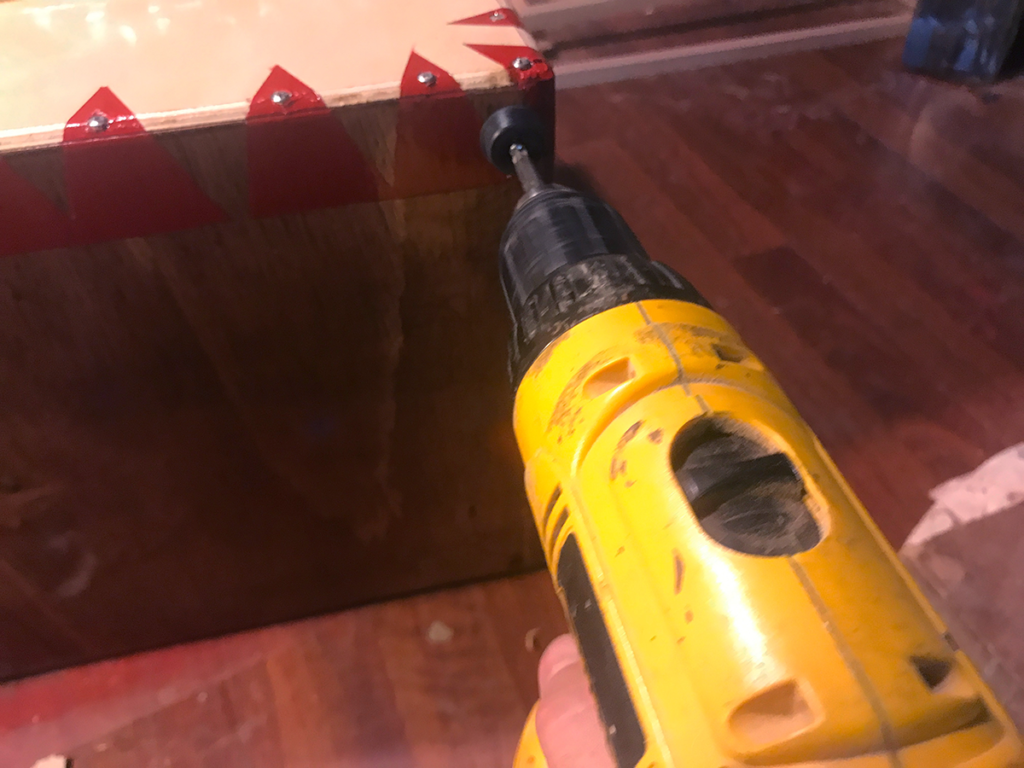
… and screwed on some little rubber feet to protect both the floor and the wood, since you’re meant to sit on the instrument to play it.
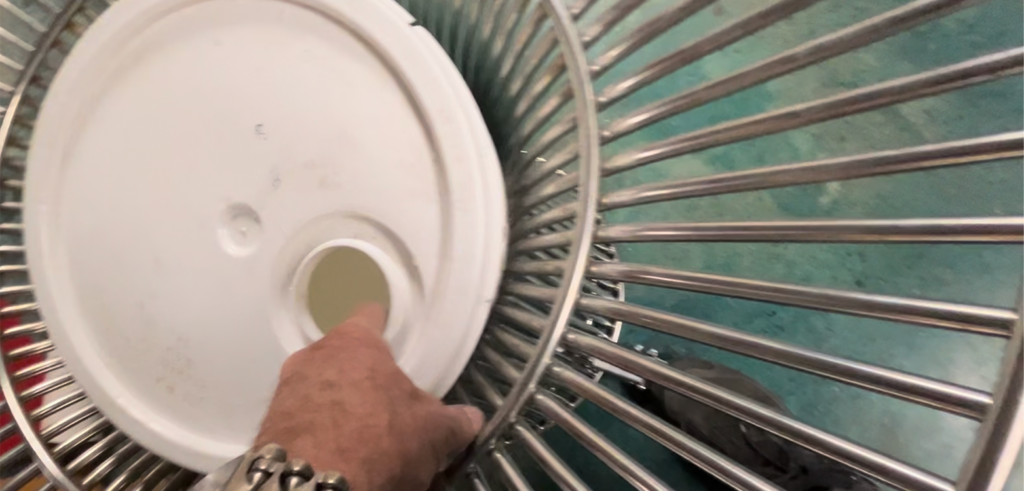
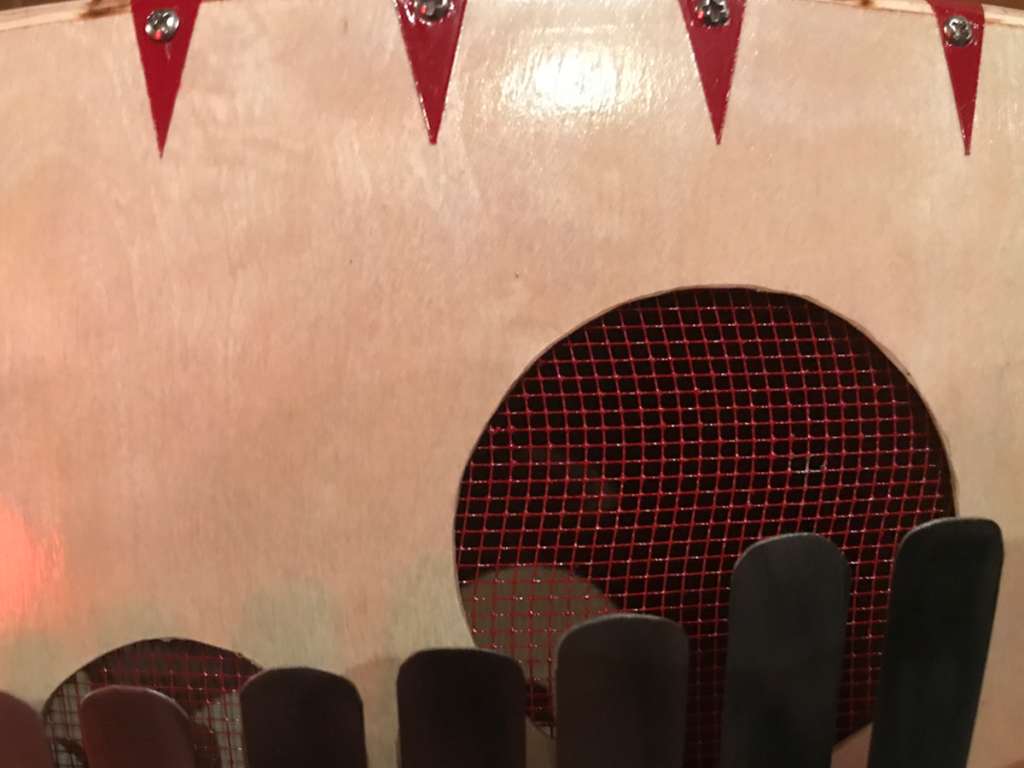
To add a little bit of drama (and filter out toys, crayons and Cheerios that younger musicians might be tempted to insert in the sound holes, I spray painted some metal fabric and glued it to the backside of the face with Liquid Nails so it wouldn’t buzz when the instrument is played.
The old-timey title for this post could have been:
The Wisdom and Benefits of Contemplating a Temporary Shift from the Traditional Norm for This Institution in Materials, Methods, Design and Construction of Multi-Purpose Acoustic Percussion Instruments:
Or, a “Box to Bang On”
Because this post is about a kick in the head. A total world-shifting creative non-sequitur from all this demanding, burly, unforgiving metal I’ve been working with for so many years.
All of a sudden I’m building cajóns. Out of wood. Where did *that* come from.
Lemme back up a bit.
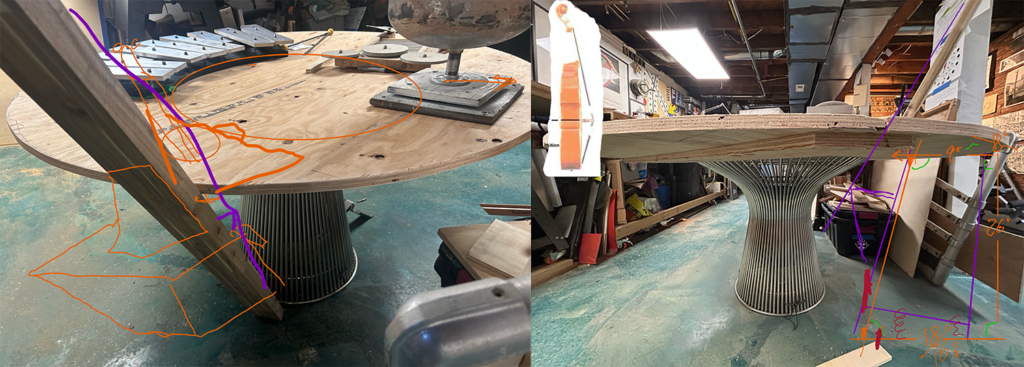
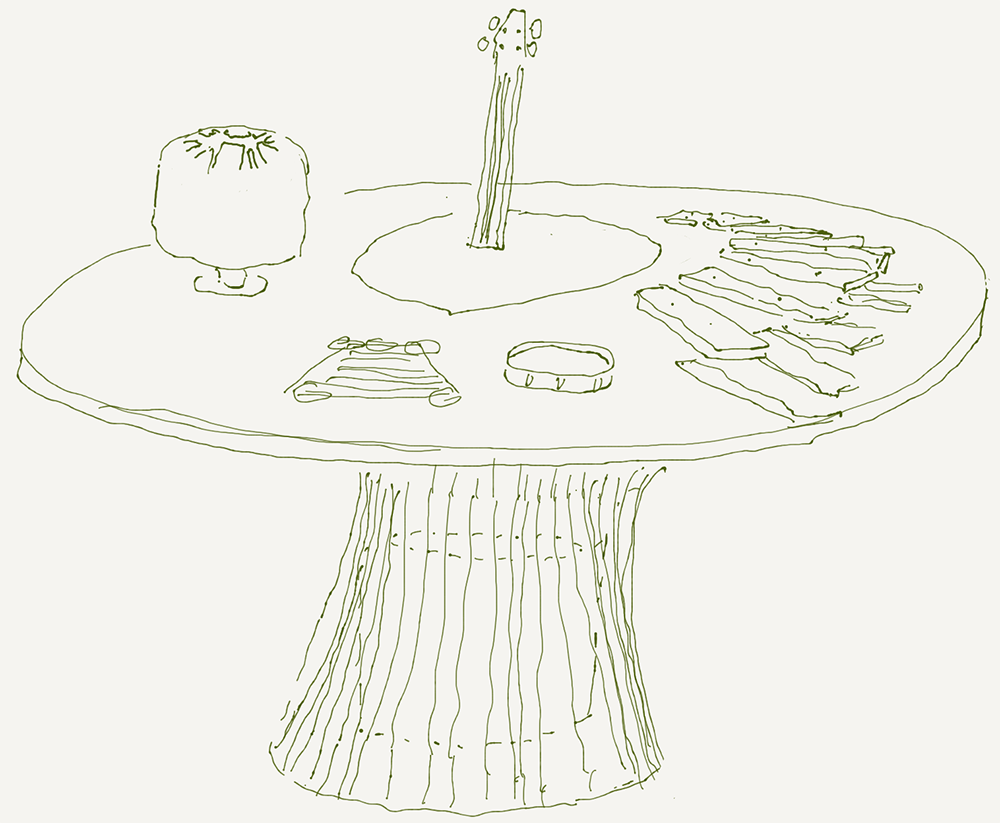
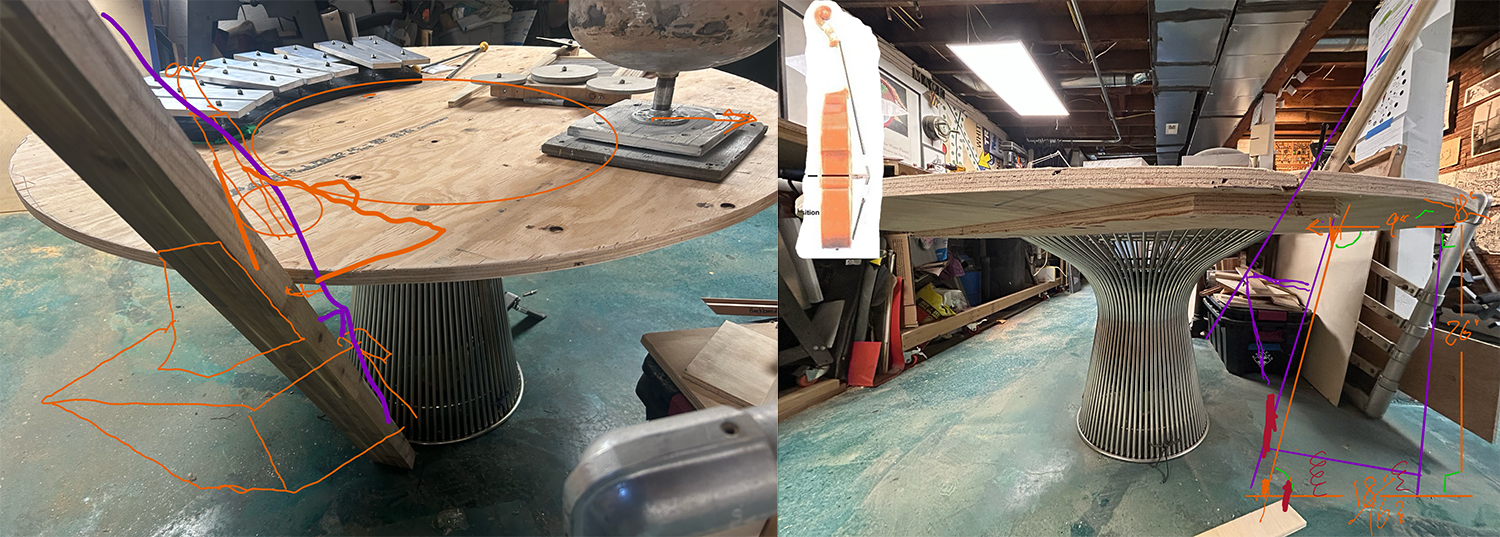
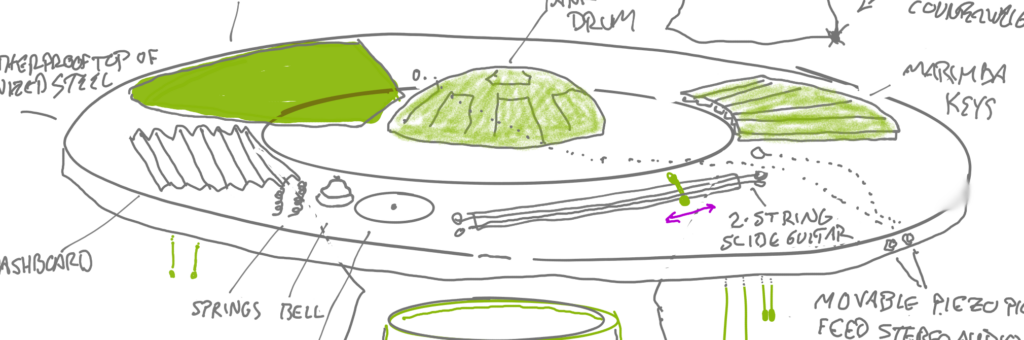
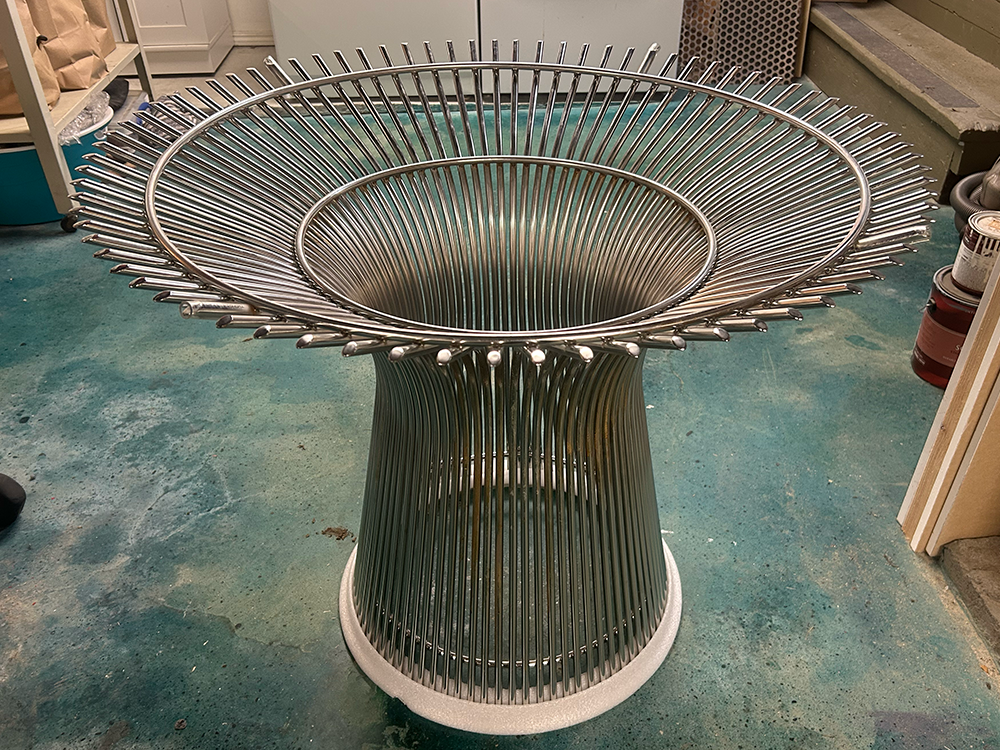
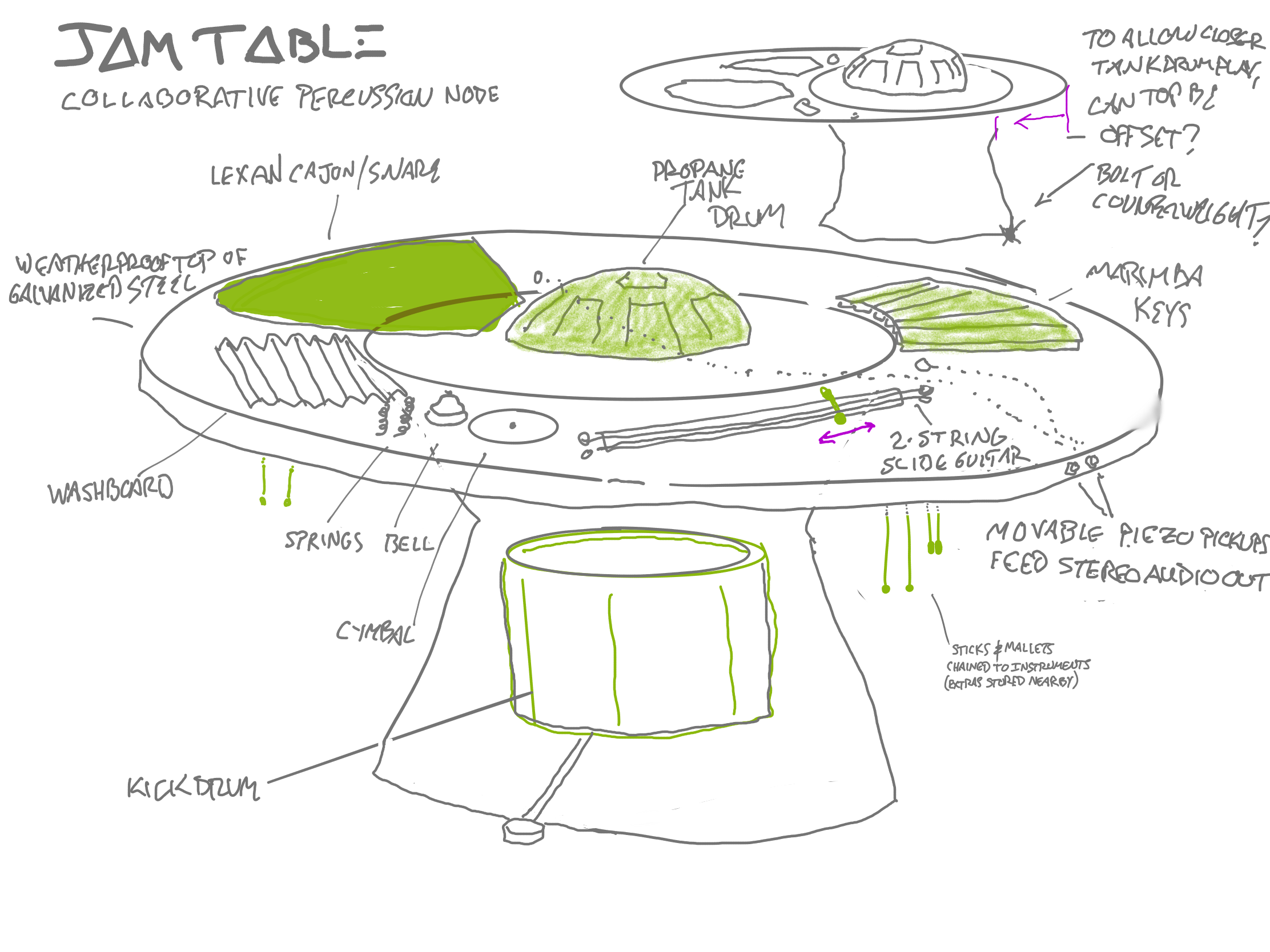
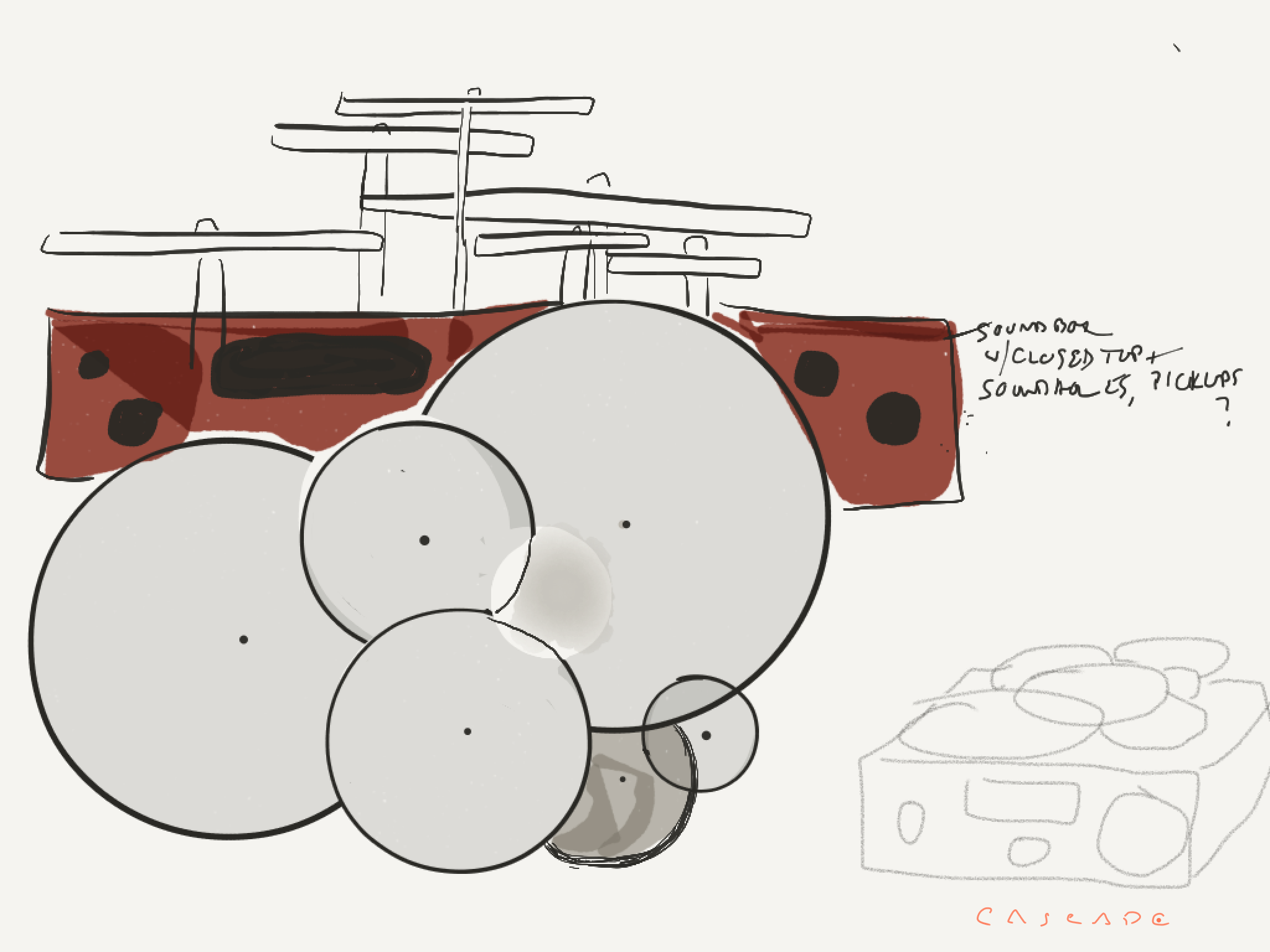
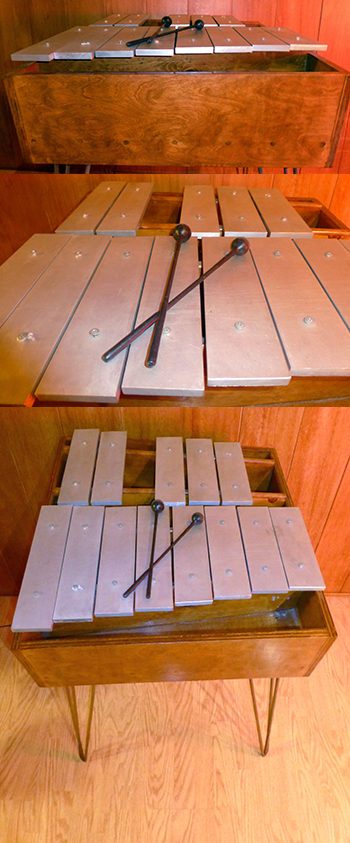
I’ve been goofing around with the idea of combining disc gongs with a sound box like the one I built a million years ago for my very first xylophone. I wanted to explore: disc arrays, resonance, materials, instrument playability.Here’s a sketch: —->
And then it occurred to me that the cajón (a sit-upon box drum with  roots in Peru and on loading docks everywhere) is such a perfect blend of structural integrity and resonance – like musical furniture – that if I could build one strong enough, it could do double duty as both metallophone and drum.
Gee, that sounds like a lot of work.
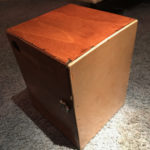
Maybe just start with building a good cajon to see if it’s easy enough. So, after digesting half a dozen how-to’s on YouTube and stealing some of the most interesting design ideas into my plan, I started my first.
Here’s a ragged build log:
Here I’m cutting pegs. I pegged/glued together the box from 1/2″ plywood, then braced its front and rear openings with 1×1 square dowels (You’ll see these later in the log – wish I’d taken more photos of that process).
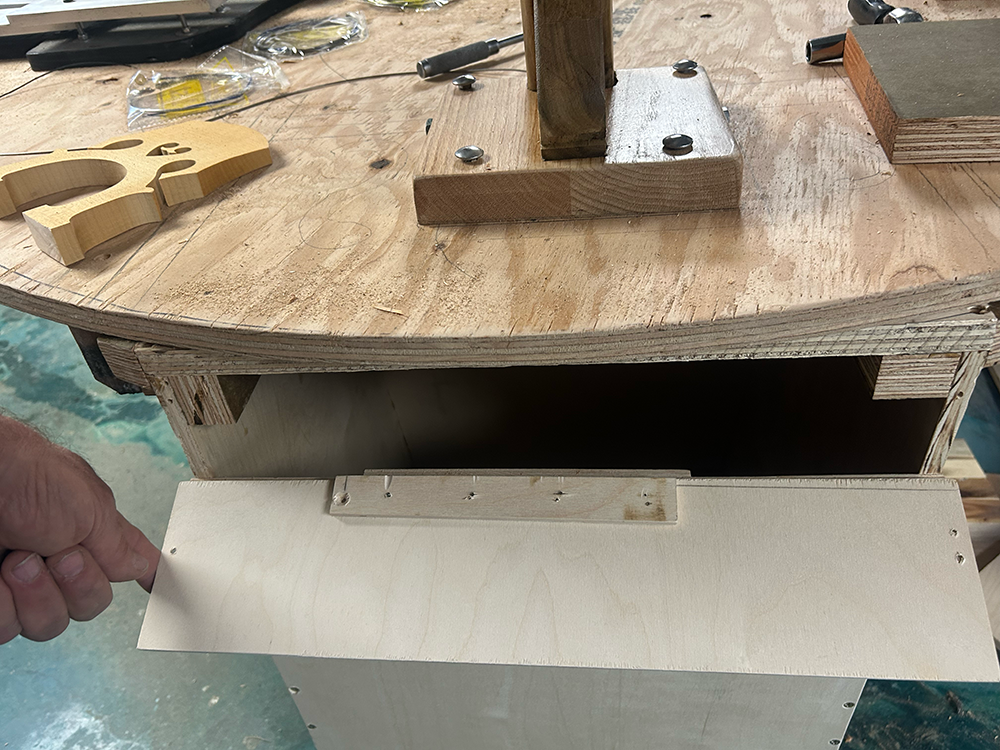
I cut sound ports into one side of the box – the bottom for bass and the top-rear for high-end (the little hole in the center-right is for the snare mechanism)
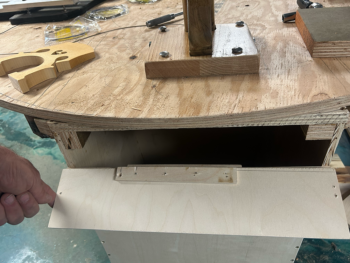
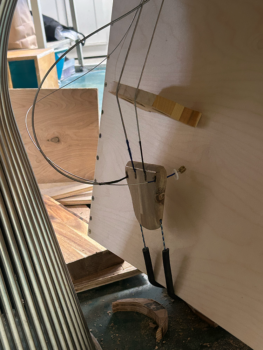
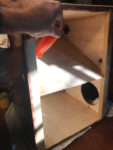
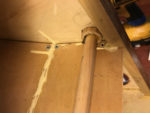
I then installed 1/4″ plywood divider panels the width of the box, dividing bass from high-end. I inserted this dowel, collared at both ends to hold it in place, so that it pivots in the little holes to allow the snares to move.
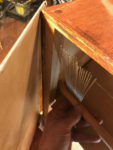
I screwed the snares (the cut halves of a whole 14″ drum snare) to the dowel and lined them up so that when the dowel rolls forward in its holes, the snares brush the inside of the playing surface.
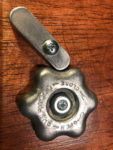
Screwed an old propane-tank valve-knob to the end of the control dowel
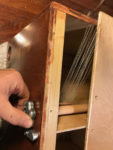
Tested it
Stained (red maple!) and varnished the box and screwed on some li’l rubber feet
Screwed on the nicely-varnished tappa
I wedged coins behind one corner of the tappa so that it warped outward a little bit (and removed them after a few days.) Now, that corner of the cajón delivers a nice “crack” note when you slap it.
This, coupled with the snares on the opposite corner and the bass notes you get when you hit the center of the instrument help it live up to its name as “drum kit in a box.”
A percussion cruise is a pretty simple pleasure: Invite people onto the roof to play the drums and gongs, and drive across the Black Rock Desert.
As I drive, happy sounds drift down – people lazily striking the gongs, and chatting passionately about their burns.
The first part of this clip is the sound of a cruise we did on Tuesday afternoon, and the latter part is part of XyloVan’s set at Sonic Runway – friends from Liminal Labs joined random Burners on the roof and around the xylophones to play.
Unfortunately, the mixer crapped out so the roof percussion drowned out the xylophones, but the sound was enough to trigger some beautiful patterns on the Runway.
(edit: I quit Facebook in 3/2018, which accounts for the missing videos.)
So, I make these musical drums out of up-cycled propane tanks. Click through for a demo video (and the build log) for Tonepod 2, the new model. Making this one, as with the others – gave me tremendous joy – which is good because the process takes about 40-60 hours and fills our basement shop with dust and noise. And yes, I might be able make one for you. Inquire here.
At this point, I have already safely emptied the tank of propane and washed out the residue of methyl mercaptan (the nasty stink agent that lets you know when odorless propane is leaking). (Seriously, don’t use any tool on metal until the propane is safely gone). I’ve cut off the handle from the top and the base ring from the bottom, and ground off the welds, and now I’m grinding off the rest of the paint before cutting … Continue reading Tonepod 2 – A new, more-portable hank drum design→
I’m not much of a player, but here’s a demo of a drum in C-minor – This is the seventh drum I’ve made out of a 20-pound propane tank.
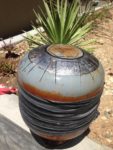
The discarded tank came into the shop in a thrashed, rusted-out pale blue, which looked amazing.
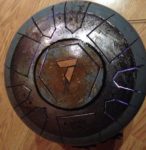
So I kept much of the original paint, cleaning off only a ring of the steel at the tips of the tongues. I then added a pinstripe ring around the hexagonal key (low-C) in the center, painted on a stylized “7”, which I limned in Sharpie – and sprayed 3 or 4 coats of clear enamel over the whole thing.
I made two major design improvements for sound – I cut out a resonator hole in the tank’s bottom (around the valve, just inside the handle).
And I’m experimenting with a new deadening material – recycled bicycle tubes wrapped around all the way around the tank to keep the body from ringing and drowning out the keys.
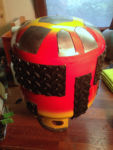
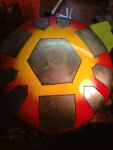
I made Fireball XL-5 for Mykal Burns, a video producer, roller derby enforcer and erstwhile percussionist. The build went something like this:
I safely emptied the propane (see the build log for Green Destiny on how to do that), rinsed and dried the tank, and then prepared the surface. This means scraping off all the paint with an angle-grinder and then in this case, sanding the hell out of the metal with 80-grit on an orbital sander.
Ooo. Satiny-smooth.
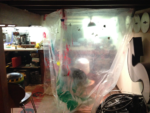
The workspace – Plastic sheeting contains the mess of metal filings, ground-off paint chip and Krylon overspray that fly around during fabrication, to keep it from polluting the area reserved for sewing, beading and, well, breathing.
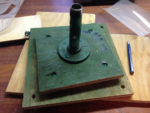
I built a stand out of a 3/4-inch flange and 5-inch nipple, which screws neatly into the tank socket where the valve fitting was removed.
Once on the stand, I can spin the tank to any angle for drawing, cutting, painting, etc.
Using Green Destiny, I traced and cut a template in thick sheet plastic.
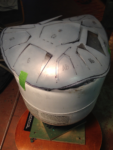
This is what happens when you put a flat template on a domed surface. You spend some time fudging and finagling to get it aligned with the center of the tank, then tweak some more to …
… trace the individual key shapes.
Use a center punch to mark all the corners – this will make drilling easier.
Drill holes through all the corner points – this makes it easier (and hella less finicky) to connect the linear cuts.
And … start cutting, with reiforced cutting wheels.
Cutting takes 4-5 hours – the Dremel gets pretty hot from being overworked. I might just upgrade to a beefier model.
Now for tuning. You tap the key and check the tone on a guitar-tuning app. This one came out G#, supposed to be G natural.
Cut the key a tad longer with a hacksaw blade …
Sweet. Tuning all the keys takes another couple of hours.
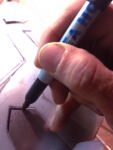
Burns wanted the note markings left on the drum, so before clearcoating the keys, I engraved them into the steel.
After spraying three coats of clear enamel onto the whole drumhead, I masked off the keys from the paint.
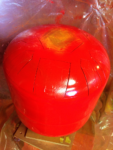
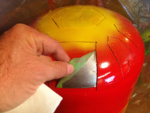
Two coats of red later, it looks a little like this.
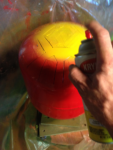
Now for the sunburst.
First peek!
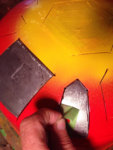
Peeling is appealing …
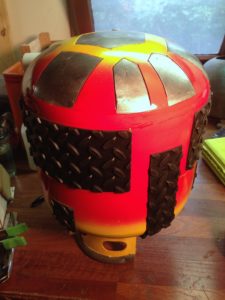
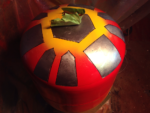
Burns requested this paint scheme – it came out pretty sweet.
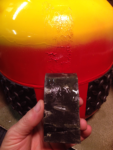
Now I apply material to damp the ringing of the drum body – The sound tends to overwhelm the sound of the keys if you don’t deaden it. I used the same type of self-adhesive rubber step-tread strips here that I applied to Green Destiny. Unfortunately, the Chinese manufacturer used shitty adhesive and they immediately started peeling off.
First I tried riveting the corners – but the riveting crushed and distorted the edges and looked awful. So I removed the rivets, and re-applied them with industrial-strength rubber cement – the solvent in which had the immediate effect of … blistering the paint. Ain’t chemistry a hoot. But precisely applied, the strips covered their own adhesion problems – and stuck fast.
Here’s the finished product – Paint scheme picked out by Mykal Burns, other aesthetic and functional nonsense was mine.
I can’t wait to make the next one. And yes, I am taking more commissions like this one. If you want me to create a drum for you, hit me up. If you want to know about the experience, ask Burns.
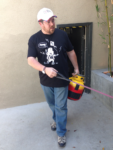
Man spotted with bizarre handmade musical instrument. Enjoy, Mykal!
If you would like me to make a drum for you on commission, the price is $300 – $250 if you bring your own empty propane tank. Contact me for details.
Perfect for Burning Man, lazy Sunday afternoons or hand-to-hand combat.
I then ratchet-strapped it to a post and put a bar on the wrench to get the needed leverage. It takes a *lot* of leverage to break the seal.
Once you’ve unscrewed the valve, take the tank – which still contains propane and methyl mercaptan residue – immediately out back and fill it with water and dish soap. Leave it overnight, then dump it and rinse and drain it dry.
I’ve written about this before, but do *not* attempt to build one of these unless you know how to safely empty a propane tank and get the valve off ot it. Just don’t. Anyway, beginning with an empty, de-valved tank, you start by using ViseGrips to break the welds holding the base in place. You have to wrench pretty hard back and forth to weaken the welds till they snap, but there are only 3 or 4 of them.
I then used an angle grinder to strip off all the paint and grind off the welds from the bottom of the tank.
This leaves a nice, textured finish.
Laying out the pattern with a compass and Sharpie. The concept of building tank drums from propane tanks should be credited to Dennis Havlena, a Michigan instrument-hacker who made his first in 2008 – (plans are here) A lot of people took up Havlena’s open-source idea – some even took off into manufacturing them.
I found a video at one maker’s site that had a tuning I liked, and hand-sketched a 10-key drum based on that design.
Here’s the pattern sketched in with Sharpie.
. Now drill holes at the corners of all the key edges. This lets you bring two cuts together cleanly without making an X if you cut a little too hard.
Then you get to making the rough cuts with a Dremel, top speed, with thin-grade reinforced cutting discs. I go through 8-10 discs during the whole process.
You cut each key a little short of what the template suggests, tape off all but the key you’re tuning, and then use a smartphone tuning app to find what the pitch is on each one.
You can find a few good tuning apps on the App Store – I’m using insTuner.
If a key is sharp – say, an E is ringing at D#, you cut it longer. If the key is flat, you have to carve off the end of the key to shorten it and raise the pitch.
After a lot of tuning (cutting takes a couple hours, and tuning properly can take three or four more) it’s mask and paint time. I’ve already sprayed clearcoat all over the keys, since I liked the way my sketched-in keys looked and wanted to preserve the design process. I then masked it off and sprayed a thick coat of yellow. I purposefully laid on a bit too much so the paint would drip and run a bit.
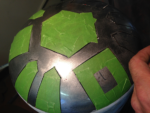
I sprayed the middle of the drum with this wild green mealflake model enamel I’ve had sitting around forever, and then sprayed the handle in black.
I wanted to add a little accent color, so I masked off triangles at the base of each key and used red Testor’s model paint.
Then – I don’t know what the f$@k came over me – I proceeded to over-pimp the triangles with Sharpie and metallic markers, and the whole thing wound up looking absolutely garishly awful. So …
I masked off everything but the level containing the ugly, and put three thick coats of yellow over it so it would blend with the rest of the top- laid on stripes of masking tape at regular diagonal intervals, sprayed the exposed stuff with black …
… et voila. No less garish, but at least it doesn’t look like a hippie barfed all over it. I even managed to keep a little bit of the detail that I did like.
I epoxied a chunk of slit garden hose to the handle to act as floor protection for the base …
I also found a terrific substitute for the damping material. To help the keys ring well, you have to nullify the entire body of the drum from ringing and overpowering them when you play. On “Little Boy,” my previous 8-key A-minor drum, I used a chunk of garden hose wrapped 7 times around the center, anchoring the ends with metal screws. On this one, I found that self-adhesive rubber strips used as non-skid-plates for stairs worked perfectly – and fit in beautifully with the aesthetic.
If you would like me to make a drum for you on commission, the price is $300 – $250 if you bring your own empty propane tank. Contact me for details.
Just a quick one – these are the gongs we made for our Indiegogo supporters, all engraved and ready for their fittings. It’s not too late to get one of your own! A $150 donation to our big Burning Man project nets you a hand-engraved gong with your slogan Or inspirational quote of choice, a dowel chime, machined aluminum block pendant and slice pendant, crew patch and sticker. Just Paypal us at factoid@well.com and tell us your inscription in the comment field and we’ll get right to work on it for you! Thanks so much to all our gong-level Indiegogo supporters!